
Smart Film on Existing Conference Room Glass: A Retrofit Guide

Glass conference room privacy does not require new walls. Switchable smart film is bonded to the room-side face of the glass that is already standing, and the room turns from clear to an even frosted white on a wall switch, remote, or keypad, usually installed after hours with no panels pulled and no demolition.
This guide covers the retrofit: what changes for the people using the room, what the install looks like, and what to check before you ask for a price. For the product options and the full list of meeting-room installs, start with our overview of smart glass conference rooms.
Why all-glass meeting rooms stop working
Glass-walled meeting rooms look right on the day an office opens. They keep the floor bright, show at a glance which rooms are free, and make a mid-size space feel larger than it is. Then the room gets used. A budget review, a hiring conversation, a client's documents, or a screen full of numbers are all visible from the hallway and the lounge. People start booking the one room with a solid wall, taking calls in the stairwell, or angling laptops away from the glass.
The usual fixes all give something up. Blinds and curtains collect dust, hang half-open, and spoil the clean lines the glass was chosen for. Frosted vinyl or a decorative band blocks the view permanently, including the open look between meetings. Rebuilding with solid walls costs a construction schedule and gives up the daylight. Switchable film is the one option that keeps the room exactly as designed until someone needs it private.
How the retrofit works on glass that's already up
The film is a thin switchable layer, custom-cut to each pane and applied to the room side of the existing glass. A copper busbar along one edge connects it to a low-voltage feed from a transformer. With power on, the film is clear. Switch it off and it scatters light into a flat, milky white in under a second. Nothing is removed: the partitions, the frames, and the door hardware all stay where they are. For how the material itself works and what glass it suits, see our PDLC smart film page.
Control is chosen to fit how the room is used:
- A wall switch by the door, the simplest control and the one visitors understand without instructions.
- A wireless remote that lives on the conference table.
- A keypad or a smartphone app, where the office already uses one.
- A building or room-control system such as Lutron, Crestron, Control4, or Savant, wired through a relay so the glass can frost with the same scene that dims the lights.
Each room, or each wall, can be its own zone. A single switch can take a whole room private at once, or a lobby wall can switch separately from the room behind it. That decision is made before the wiring goes in, so it belongs early in the conversation.
What changes for the people inside the room
The room behaves the way people already assumed a glass room should. It is open and see-through when nobody needs privacy, then a closed, even white the moment the meeting starts. Frosted glass still passes daylight, so an interior room without windows stays bright instead of turning into a box.
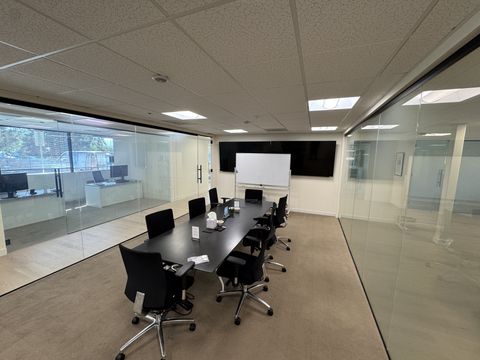
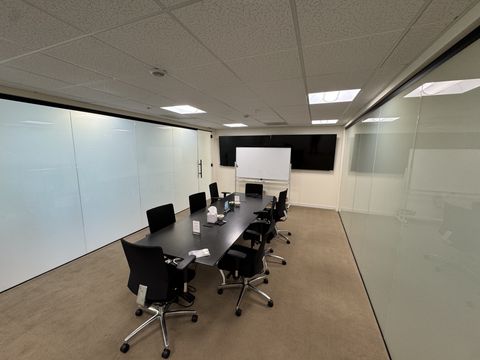
That corner boardroom is one of four conference rooms in a Thousand Oaks office where we filmed the glass walls: 433 sq ft of smart film across the four rooms and the lobby lounge glass, applied to the existing frameless partitions and swing doors. The door leaves were filmed along with the fixed panels, so a closed room reads as one solid white wall rather than a frosted room with a clear door.
Two things do not change, and it is better to know them up front. First, frosting is visual privacy, not sound control. A conversation is as audible through frosted glass as through clear glass, so acoustic needs belong to the partition and door seals. Second, the resting state is private. If power drops, the glass frosts rather than exposing the room.
There is one bonus many offices only find later: frosted film works as a rear-projection surface, so a short-throw projector behind the glass can turn the wall into a display. The details are in can smart film work as a projection screen.
What install night looks like
Because nothing structural changes, a retrofit fits around the working week. A typical one- or two-room job is a single install window, and we schedule it after hours or over a weekend so the room is back in rotation the next morning. On the night, the crew cleans each pane, applies the pre-cut film to the room side, connects the busbars, mounts the transformer near the power source, wires the control, and switch-tests every zone before leaving.
A smaller job can be as simple as the Beverly Hills escrow office conference rooms: about 100 sq ft of film on the glass partition walls of two rooms, each wired to a single wall switch so staff can frost the room as a confidential client meeting starts. In a leased suite, a film retrofit is also an easier approval than replacing glazing, since the building's glass stays in place. If your building requires certificates of insurance, freight-elevator bookings, or set access hours, tell us early and we will schedule around them.
What to check before you ask for a quote
A useful estimate comes from a handful of facts. Gathering them first gets you an accurate number faster:
- Pane count and sizes. Count every pane in each glass wall and note rough width and height. Frameless runs, mullions, and transom panes all count separately.
- Door panes. Note every glass door and whether it swings or slides. A moving leaf needs its own power route, crossing at the hinge side or through the head track, and that is planned before the film is cut.
- Access to power. Mark where the nearest outlet or electrical access is. Each independently switched zone needs its own transformer, and the distance from the glass to the power changes the wiring work.
- How you want it to switch. One switch per room, one for the whole floor, or tied into an existing control system.
- The glass itself. Smooth, flat glass, including tempered glass, is the normal case. Textured or previously tinted glass changes the answer, and photos let us flag it before you spend anything.
- Building rules. Whether after-hours access is possible, and what paperwork the building manager requires from contractors.
Photograph each glass wall from the open-floor side, with the doors in the shot. That set of photos plus rough sizes is usually enough for a free written estimate.
How the cost is figured
Retrofit pricing follows the glass, not the room count alone. Total glass area, the number of rooms and zones, the control you choose, and how hard it is to get low-voltage power to each frame are what move the number. The useful anchor: a single small panel usually starts around $1,500 fully installed and scales from there. A meeting room is rarely one small panel, so most quotes track the room's total glass area. Filming glass that is already in the frame skips new glazing entirely, which is why nearly every commercial quote we write goes that way. The full breakdown, with a real itemized estimate, is on our smart glass cost page.
If the meeting rooms are part of a wider plan, such as private offices, a reception wall, or an open floor that needs a few quiet zones, our guides to smart glass for office spaces and smart glass for open-plan offices cover where else the switch earns its place.
Common questions from office managers
Does frosting the glass stop people hearing the meeting?
No. Switchable film removes the sightline, not the sound. Acoustic separation comes from the partition, the door seal, and the ceiling, so specify it there if the room needs it.
Can the glass doors be frosted along with the walls?
Yes. Door leaves take the same film as the fixed panels, with the power feed crossing at the hinge side or through the head track. That route is planned before the film is cut, so mention every door in the room when you ask for a quote.
How long does the install take, and does the office have to close?
A typical one- or two-room job is a single install window, scheduled after hours or over a weekend so the room is back in use the next morning. Nothing is demolished and no glass is replaced.
What happens to the room if the power goes out?
The glass frosts. The film is clear only while it is powered, so a power cut leaves the room private rather than exposed, and daylight still passes through.
Ready to price your rooms? Send photos of your glass walls with rough sizes and the number of rooms, or call (866) 728-9888. You will have a written estimate within one to two business days.