Which Switchable Privacy Glass Works Best for Office Pods?

For most office pods, the best switchable privacy option is retrofit PDLC smart film bonded to the glazing the pod already has: it frosts to an even white in milliseconds, runs on low voltage, and needs no panel replacement. Factory-laminated switchable glass is the better fit when a booth or focus room is being built new.
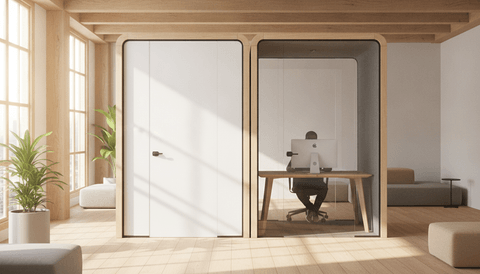
If you've been comparing switchable privacy glass for office pods — the prefab phone booths and focus rooms that now anchor most open-plan floors — the choice is simpler than the product pages make it look, and it mostly turns on whether the pod is already standing.
Why a glass pod still needs a privacy switch
Pods earned their place by solving sound. A phone booth takes the sales call out of the room, a focus pod gives deep work somewhere to happen, and a meeting pod swallows the stand-up. What none of them solves is sight: the same glass that keeps a booth from feeling like a closet puts its occupant — and their screen — on display to the whole floor.
That matters more than teams expect. Interviews, HR conversations, payroll, a telehealth appointment on a lunch break: people skip the booth precisely when they need it most, because everyone can watch even if nobody can listen. Blinds are a poor patch at pod scale — they rattle in the doorway, gather dust, and cover the glass that makes the pod livable. Permanent frosting turns it into a box. A switching layer keeps openness as the default and makes privacy a one-press decision.
Retrofit film or a factory-laminated panel?
Both are the same PDLC technology in two forms, and the pod decides between them. Retrofit smart film bonds to the interior face of the glazing the pod already has. Powered, the pane reads as ordinary clear glass; unpowered, it rests in a flat, even, milky-white frost that removes the sightline in both directions while daylight keeps passing through.
A factory-laminated switchable panel carries that same layer sealed inside a new piece of glass. It is the right call when a booth or focus room is being built from scratch, or when a pod's glazing is being replaced anyway — the fabricator sets the finished panel like any other lite, and the switching layer lives protected inside the glass for the life of the booth.
For the pods most offices already own, film wins on every practical count: no disassembly, no reglazing, and no downtime beyond the visit itself.
Can a prefab pod be retrofitted where it stands?
Usually, yes. Flat, smooth, clear panels — the standard glazing on most prefab booths and site-built focus rooms — take the film in place, and a single pod is typically finished well within a day. The exceptions are curved fronts and specialty coated or heavily tinted acoustic glazing, which we evaluate from photos before quoting rather than promising blindly.
It is the same in-place approach as our smart film office renovation in San Diego, where a standard meeting room's existing glass picked up the switching layer with no construction and no new glazing — a pod is that job at booth scale. One honest boundary: this is not a peel-and-stick kit. Switchable film creases permanently if it is mishandled, and a pod's glass front is an unforgiving place to learn, so we supply film to licensed trades and install with our own crew.
How does a freestanding booth power the glass?
More easily than people assume. Most pods already carry power for their lighting and ventilation, and the film runs on low voltage through a small transformer — it ties into that existing feed or plugs into the outlet inside the booth, confirmed during the estimate so there are no surprises on install day. Site-built focus rooms are wired like any partition, with the low-voltage run handled by our licensed crew (CA lic. #1134029).
Control usually lives inside the pod, where it belongs: a switch by the occupant's elbow, with remotes and grouped controls available when facilities wants every booth on one handset. And because frosted is the unpowered state, a pod that gets unplugged and rolled across the floor simply stays private until it is powered again — the fail-safe points in the right direction.
What switchable pod glazing costs
A single small pane usually starts around $1,500 fully installed and scales with panel count and controls — a phone booth's glass front is one of the smaller jobs we do, and a fleet of pods across a floor is quoted per project. Booths are also rarely the whole story: the same layer goes onto conference fronts, partitions, and glass-walled private offices, and our smart glass for offices page covers that wider program.
Questions buyers ask before switching a pod
Can smart film be added to a pod that's already installed?
Usually, yes. The film bonds to the interior face of the pod's glazing where it stands — no disassembly and no new glass for flat, smooth panels. Curved or specialty-coated glazing gets evaluated from photos before we quote.
Does the pod stay private if it loses power?
Yes. Frosted is the unpowered state, so unplugging or moving the pod simply leaves its glass private. Power is only needed to hold the panels clear.
Will the frosted pod feel dark inside?
No. The frost is a translucent white that keeps daylight and office lighting passing through, so the booth stays bright. It removes the sightline, not the light.
What does switchable glass for one pod cost?
A single small pane usually starts around $1,500 fully installed and scales with panel count and controls. The estimate is free and remote — send photos and rough dimensions to Smart View Film Solutions and you'll have real numbers within one to two business days.
If the booths on your floor sit empty during exactly the conversations they were bought for, the fix is a switch, not a curtain rail. Request a free estimate or call Smart View Film Solutions at (866) 728-9888 — send a couple of photos and rough dimensions, and you'll have real numbers within one to two business days.