
Smart Glass for Medical Clinics: 7 Top Picks (2026)

Medical clinic privacy is a regulated category. HIPAA enforcement, state-level patient-confidentiality requirements, and accreditation-body site visits all touch the privacy spec on consultation rooms, exam rooms, procedure suites, and front-desk glass. Switchable smart glass solves these privacy requirements with a documented, controllable, and auditable spec that traditional treatments (curtains, blinds, frosted vinyl) struggle to match.
This guide walks the seven smart glass for medical clinics spec picks we recommend on every clinic-build consult. Each comes from real installs we’ve shipped across LA-area outpatient clinics, surgery centers, dental offices, dermatology suites, and specialty medical practices in the last 12 months.
Why Clinics Are a Different Spec From Office or Retail
Medical clinic installs differ from generic office or retail spec in three specific ways: regulatory documentation (the privacy spec needs to defend the clinic during HIPAA audits and accreditation site visits), patient-experience expectations (the spec must read as clinical and credible, not gimmicky), and infection-control compatibility (the surfaces need to wipe down with hospital-grade disinfectants without degrading the spec). The seven picks below address those constraints directly.
Below are the medical-clinic-specific smart glass picks we run on the consult.
The 7 Spec Picks
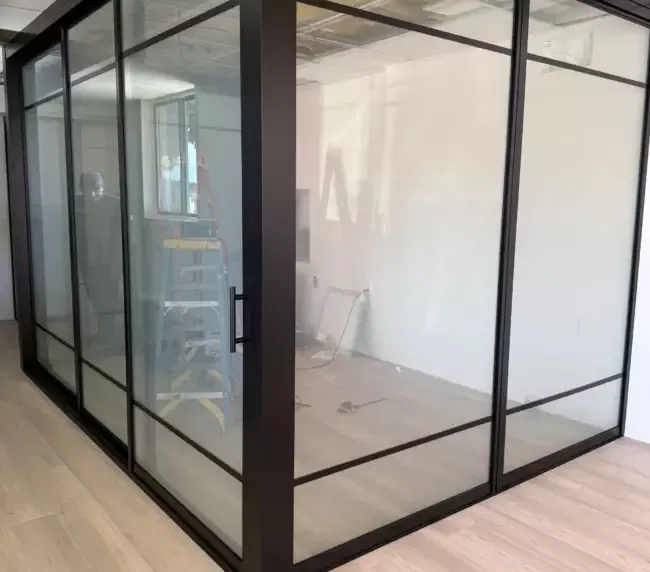
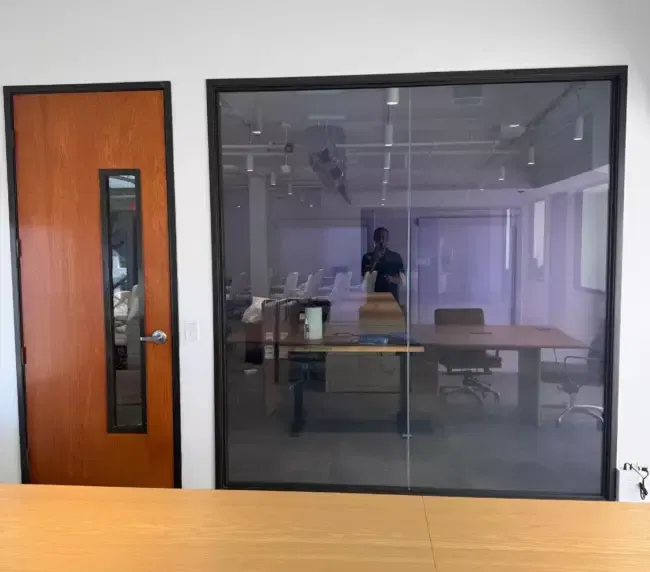
- 1. Consultation-room glass-wall privacy on demand. The most common medical spec. Switchable smart glass on consultation-room glass walls gives the provider instant patient-confidential privacy when the door closes, then back to clear when the room is between patients — supports both privacy compliance and operational visibility for staff.
- 2. Exam-room partition switchable spec. Exam rooms in higher-volume clinics often share a partition wall between rooms or to a central corridor. Switchable glass on that partition supports clinical workflow visibility (staff can see room status at a glance in clear mode) while flipping to private during patient exams.
- 3. Procedure and minor-surgery suite privacy. Surgery centers, dermatology suites, and procedure rooms with glass walls require absolute privacy during patient procedures. Switchable smart glass delivers reliable, fast, instantly-private spec without permanent treatments that read as institutional.
- 4. Front-desk and check-in glass privacy management. Many clinic front-desk areas have glass partitions between check-in staff and the waiting area. Switchable film on those partitions lets staff handle confidential patient-info conversations privately when needed, then return to clear for general patient interaction.
- 5. Pediatric and family-experience clinic spec. Pediatric and family-clinic environments benefit from the playful, on-demand quality of switchable glass — kids and families respond positively to the technology, which improves the clinical experience perception. Particularly effective in pediatric dental and family-medicine waiting areas.
- 6. Infection-control compatible spec. Quality professional-grade switchable smart glass tolerates hospital-grade disinfectant wipe-down (alcohol-based, quaternary ammonium, hydrogen peroxide solutions) without degradation. Spec’d correctly, the glass surface integrates into the clinic’s existing infection-control protocol seamlessly.
- 7. Telehealth and video-consult room spec. Telehealth-equipped consult rooms need controllable backgrounds — clear mode shows the clinical credibility of the room behind the provider; frosted mode prevents background distractions during patient video calls. Switchable spec on the relevant glass supports both modes from one product.
For broader context on what a credible medical-spec smart glass company looks like (team experience, install discipline, regulatory awareness), see our smart glass company page — covers the company-side answers most relevant to clinic property managers and practice owners.
Where It Pays Back Most Clearly for Clinics
Across the LA-area medical installs we ship, the switchable-glass spec earns its cost back fastest in three clinic types:
- Surgery centers and dermatology suites with procedure-room privacy requirements. Picks #3 (procedure suite) and #6 (infection-control compatibility) compound — the privacy and clinical-tolerance value scales across multiple procedure rooms.
- Multi-provider outpatient clinics with high consultation-room turnover. Pick #1 (consultation-room privacy) is decisive on its own — the per-patient privacy switch is faster and cleaner than blinds or curtains, which improves room-turnover efficiency.
- Family and pediatric clinics competing on patient-experience differentiation. Pick #5 (pediatric experience) plus pick #2 (exam-room partition) compound — the technology reads as forward and family-friendly, which supports the clinic’s positioning.
How the Specs Compound Across a Multi-Room Clinic
The seven picks above don’t sit in isolation — on a typical mid-size LA medical clinic with 4 consultation rooms, 2 procedure suites, front-desk partition, and a telehealth room, four to six of these picks compound on the same install. The cabling spec, driver placement, and BMS or app control scale cleanly across rooms because the underlying switchable-glass product is the same — only the room context differs. The per-room cost drops as the clinic-wide install scales.
For multi-room clinic specs, this means a clinic-wide switchable-glass standard can serve very different room contexts under one control system — consultation, exam, procedure, front-desk, telehealth — all unified under one app or BMS. The regulatory-documentation story benefits as well: a single spec across the clinic is easier to document for HIPAA and accreditation audits than a patchwork of treatments.
The Specs in Real Project Math
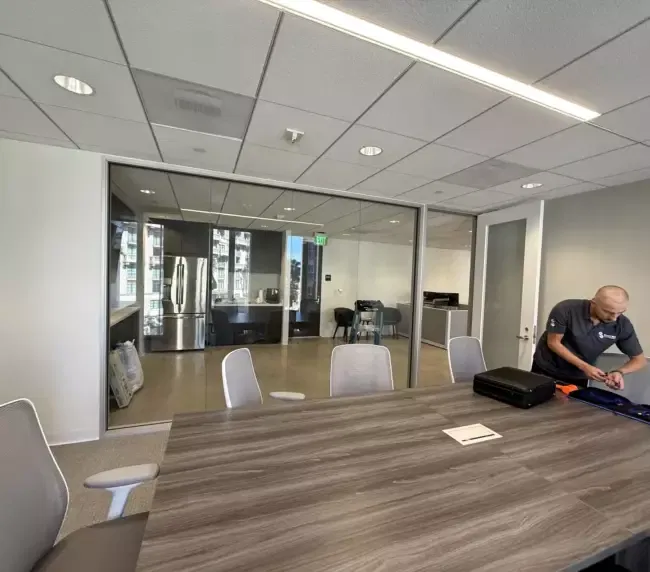
For a typical LA outpatient clinic with consultation-room privacy on 4 rooms (~100 sq ft of glass total), the smart glass package is quoted in writing after a measurement. For a full clinic spec covering consultation + procedure + front-desk + telehealth (~250 sq ft total), spec is quoted in writing after a measurement — the per-room cost drops as the clinic-wide install scales.
The recurring alternative cost — replacing curtains, repairing broken blinds, re-frosting vinyl that lost adhesion, recalibrating mechanical privacy treatments — runs $3,000–6,000 per year across a mid-size clinic. The switchable spec pays back in roughly 5–7 years on maintenance and replacement spend alone, not counting the regulatory-documentation and patient-experience value.
A Beverly Hills Surgery-Center Reference
For a concrete example of these clinic specs applied end-to-end on a single project, our Beverly Hills surgery-center install hits five of the seven picks directly. Procedure-room privacy on 2 surgical suites (pick #3), consultation-room glass on 4 prep rooms (pick #1), front-desk partition (pick #4), and infection-control-compatible spec across all surfaces (pick #6) — all on a unified app-control system that ties into the clinic’s existing BMS.
Full project breakdown: smart glass surgery center in Beverly Hills — same spec playbook applied to a single medical project.
Planning a Medical Clinic Smart Glass Install?
Every install we do across the LA metro is backed by a one-year workmanship warranty, so you are not guessing on the finish. Send your project details through the contact page and we will scope it and quote it.