
Smart Film You Can See Out but Not In: The Honest Answer

No switchable film is truly one-way: when the film frosts for privacy, it blocks the view in both directions, and mirror-style products that let you see out while others can't only work while it's brighter outside than in. What switchable film offers instead is privacy on demand — a window that stays perfectly clear until you frost it at one press.
If you've been searching for smart film you can see out but not in, that first paragraph is the honest answer most sellers won't lead with. Here's why the one-way effect behaves the way it does, and why homeowners who came to us asking for it usually end up happier with a switch.
Why one-way privacy is mostly a daytime illusion
Picture the mirrored office tower: people inside watch the street all day, and the street sees only sky. That effect doesn't live in the glass — it lives in the light. A reflective coating bounces the brighter side back at whoever is looking, so as long as the sun keeps the outside brighter than your interior, passers-by see a mirror and you see out.
At dusk the balance flips. Lamps make your side the bright one, the mirror reverses, and the room becomes visible to the whole street — while you mostly see your own reflection. The one-way effect quits at exactly the hour you want privacy most, and no coating avoids that physics: it is a light imbalance, not a property of the product.
The other cost is permanence. A reflective finish gives the house a mirrored look from the sidewalk, dims the room all day whether you wanted shade or not, and has no off switch when you'd rather wave at the neighbors.
What switchable film does instead of the mirror trick
PDLC smart film bonds to the glass already in your frames and gives it two states. Powered, the liquid-crystal layer aligns and the pane reads as ordinary clear glass — full view, full daylight, no tint. Unpowered, it rests in a flat, even milky white that removes the sightline completely, from both sides, day or night.
It never does both jobs in the same instant — nothing honestly does after dark — but it does each one perfectly, on your schedule. Tap a wall switch, a remote, or a phone app and the whole pane changes in milliseconds. And because the film frosts whenever power is off, a tripped breaker leaves your windows private rather than exposed. The low-voltage wiring is run discreetly by our licensed crew (CA lic. #1134029), with the control wherever you actually stand — by the sofa, not behind it.
The living room that kept its view
The photos below are one of our own installs — a smart film retrofit on a street-facing Los Angeles living room. The bay window looks straight onto the sidewalk and the houses across the street: exactly the room people have in mind when they ask about one-way glass.
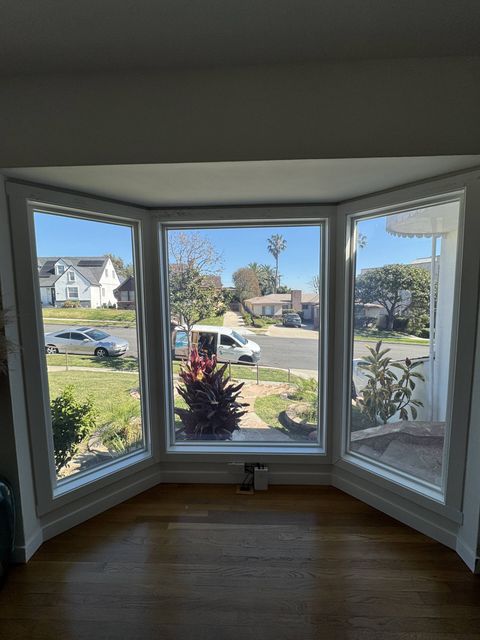
Clear, the family sees the whole street and every bit of their light. Frosted, all three panels turn a soft bright white — nobody on the sidewalk sees in, and the room stays daylit instead of going dark behind curtains.
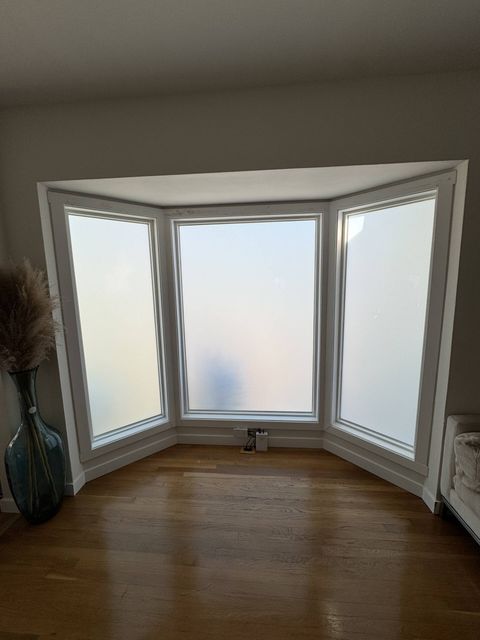
That's the practical answer to the one-way wish: the view is yours whenever you want it, and the privacy is total whenever you need it — instead of a fixed compromise that's partly both and reverses at night.
Which approach fits which problem?
If your only concern is daytime passers-by — a home office you never use after dark, say — a reflective finish can be a cheaper patch. Go in knowing the trade: mirrored curb appeal, a permanently dimmer room, and zero privacy once the lights come on.
If what you actually want is to keep your view and be genuinely unseeable on demand — evenings included — that's the switchable answer, and it's why the search that starts at one-way usually ends at a switch. One honest boundary applies here too: the frost softens harsh glare, but it is not a solar-control product, and we don't claim heat-rejection figures for film — manufacturer spec sheets are available if you need documentation. Pricing-wise, a single small window usually starts around $1,500 fully installed and scales from there with glass area and controls; the smart glass cost guide breaks down what moves the number.
Questions about one-way privacy and switchable film
Is there a smart film that lets you see out while blocking the view in?
No. When switchable film frosts, it is opaque from both sides — that's what makes the privacy real. Products that appear see-through from one side only are reflective coatings that depend on daylight, and they reverse after dark.
Can I frost some panels and leave others clear?
Yes. Each pane can sit on its own circuit with its own control, or the whole window can switch together. Frosting the lower panes for privacy while the transoms stay clear for sky is a common living-room setup.
Does the frosted state make the room dark?
No. The frost is a translucent white, so daylight keeps passing through and the room stays bright — it blocks the view, not the light. It is privacy, not blackout: pair it with a shade if you need a fully dark room.
What does smart film cost for a living room window?
A single small window usually starts around $1,500 fully installed and scales with glass area, panel count, and controls. The estimate is free and remote — send photos and rough dimensions to Smart View Film Solutions and you'll have real numbers within one to two business days.
If a mirror finish has been the plan, send us a photo of the window first. Request a free estimate or call Smart View Film Solutions at (866) 728-9888 — we'll tell you honestly which answer fits, within one to two business days.