
Smart Film for Glass Doors: Sliding, French, and Patio

Smart film for glass doors is a switchable PDLC layer bonded to the glass already in the door: powered, the panel reads clear; unpowered, it settles into an even white frost. It suits sliding and patio doors, French doors, and interior office doors. The glass is the straightforward part — the wiring is what changes from door to door.
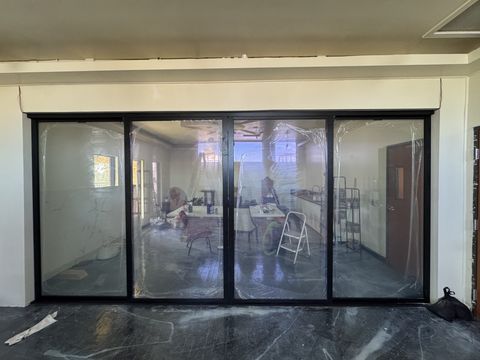
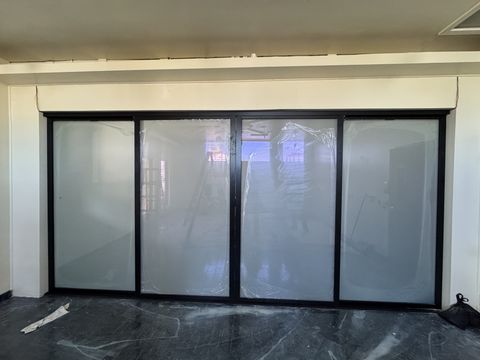
Doors are usually where people first notice the problem. A window can be covered with a shade; a door has to keep working as a door. Blinds rattle against a slider every time someone walks through, curtains snag on French door hardware, and permanent frosting takes the light and the view away for good. Switchable film is the one option that leaves the door behaving normally and still delivers a glass door that changes from clear to frosted on demand — an off switch for the sightline.
Which glass doors can switch from clear to frosted?
Sliding and patio doors are the most common request we get in Los Angeles (our smart glass sliding doors page covers both routes for them) — large panels, a lot of exposed glass, and usually a neighbor, a walkway, or a pool deck on the other side. French doors come next, normally for a home office, a bedroom, or a street-facing entry — like the 29 square feet of French-door and kitchen-door glass we frosted around a Burbank home office, every pane switching together on one handheld remote (both routes for that door type are on our smart glass French doors page). Interior office doors and pocket doors round it out: the glass keeps a small room from feeling like a closet, and the frost covers the moments when it shouldn't be a fishbowl.
What rules a door out is rarely the door itself — it's the glass. Textured, heavily tinted, or curved glass doesn't take the film cleanly, and a failing seal in a double-glazed unit should be dealt with before anything is bonded to it. Entry doors with glass lites are workable too, with the extra considerations that come with laminated safety glass and an exterior-facing surface.
Glass doors that turn opaque this way are one slice of a wider product — the same switchable layer goes onto windows, partitions, and whole glass walls. If you are still mapping what the technology is and does, our plain-English overview of glass that turns opaque with a switch covers it in one place.
The wiring question a moving panel creates
This is what separates a door job from a window job. A window is fixed: run the low-voltage lead to it once and forget about it. A door moves, and the power has to either move with it or stop at the panels that don't.
On a slider, the answer is planned around the track. Fixed panels are simple, and an operating leaf gets its lead routed through the frame and head track so nothing is visible, pinched, or under strain as the door runs. On French doors the feed crosses at the hinge side, hidden inside the jamb, the same way a hardwired door contact does. Either way it is decided before the film is cut, not after — retrofitting a wiring path into a finished door is how installs turn into callbacks.
You can also sidestep the question entirely. Plenty of projects frost only the fixed panels and leave the operating leaf clear, or put every panel on its own circuit so the whole set switches together. The smart glass sliding doors we installed in Gardena are the second version: 125 square feet across three sliding conference-room doors, all switching from one handheld remote. KNR Sliding Doors built the door systems; our crew handled the switchable film and the electrical integration.
Retrofit film, or a new switchable glass panel?
If the doors are already in and you like them, smart film bonds to the glass in place. No demolition, no reglazing, no waiting on a door order — the doors you already own start switching.
If you are specifying new doors, or the existing glass is single-pane, damaged, or the wrong type, the cleaner route is a laminated switchable panel: the PDLC layer arrives sealed inside the glass unit and the door shop sets it like any other lite. It costs more up front and takes longer to arrive, but the switchable layer sits protected inside the glass for the life of the door.
One route we won't recommend either way is a peel-and-stick kit on your own patio door. Switchable film creases permanently when it's mishandled, and door glass — large, vertical, and usually in full sun — is the least forgiving place to learn on. We supply film to licensed contractors and glaziers, not to homeowners installing it themselves.
What a switchable door costs and how long it takes
A single small window usually starts around $1,500 fully installed, and doors scale from there with glass area, panel count, and how the controls are zoned. A pair of French doors is a modest job; a four-panel slider spanning a living room wall is a bigger one; a run of office doors is quoted per project. Our smart glass cost page breaks down what actually moves the number.
Timing tends to be the pleasant surprise: most door installs are a single day on site. Our licensed crew (CA lic. #1134029) preps the glass, applies the film, runs the low-voltage leads, and power-tests every panel before leaving. Send photos and rough dimensions and real numbers come back within one to two business days.
Questions people ask about switchable doors
Will the film stop the door from opening or sliding normally?
No. The film adds well under a millimeter to the glass and nothing at all to the hardware, so the door keeps its normal action. The only thing that changes is the wiring path, and that is planned so nothing catches as the door moves.
What happens to the doors when the power goes out?
They go frosted and stay frosted. PDLC rests opaque and only turns clear while it's powered, so an outage leaves your doors private rather than exposed — and they still open and close as usual.
Can I frost just one door out of a set?
Yes. Each panel can run on its own circuit and its own switch, or the whole set can be grouped onto a single remote. It's decided during the walkthrough, because the number of zones drives the transformer count and the wiring plan.
Does smart film work on shower doors?
It's possible with a silicone edge seal, but we don't recommend it on a door that takes daily direct spray. Constant water at the film's edges works at the bond and the wiring, so smart glass is the better choice: a sealed laminated panel, with the switchable layer and its connections inside the glass. Film still suits a bathroom window or a door outside the spray zone. Our smart glass shower doors page covers how those panels are fitted.
Does switchable film keep the heat out of a sunny patio door?
Not meaningfully. Frost diffuses glare and softens harsh light, but it is not a solar-control product and we don't claim heat-rejection figures for film — manufacturer spec sheets are available if you need documentation. If solar heat is the real problem, say so early and we'll tell you honestly whether film is the right tool.
Sliding, French, or interior — describe the doors, send a couple of photos, and we can tell you what's possible and what it costs. Request a free estimate or call Smart View Film Solutions at (866) 728-9888, and you'll have numbers within one to two business days.