
Double-Glazed Smart Glass: How Insulated Units Work

Double glazed smart glass is an insulated glass unit in which the switchable privacy layer is laminated inside the inner pane, sealed behind a gas-filled gap and an outer sheet of glass. It switches from clear to frosted like any smart glass, but it is built to be the weather-tight exterior window itself, not something added to one later.
That distinction matters more than the name suggests. People land on this question from several directions: an architect specifying a new exterior opening, a homeowner with a view window and a neighbor, someone who searched for double layer smart film and is not sure what they found. The answers differ, and the most expensive mistake is ordering a sealed unit when the glass you already have would have taken a film retrofit in a day. Here is how the insulated build is put together, when it is the right answer, and what it costs.
What is actually inside the sealed unit?
Take one of our factory-built picture windows apart and you would find, from outside to inside:
- The outer pane: 5 mm Low-E tempered glass for solar and heat control.
- The gap: a 16 mm argon-filled space held open by a warm-edge spacer, which is where most of the insulation comes from.
- The switchable inner pane: two sheets of 5 mm tempered glass laminated with EVA around the PDLC smart layer, so the liquid-crystal film is sealed inside glass on both faces.
- The perimeter seal: the outer pane and the switchable pane closed up as one double-glazed unit, then set in a thermally broken aluminum frame.
Putting the smart layer on the inner pane is deliberate. It never touches outside air, rain, or the moisture that can collect between panes in a poorly sealed unit, and it sits on the side of the window that faces the room. Powered on, the liquid crystals line up and the glass is clear. Powered off, they scatter light and the whole pane turns an even milky white. Privacy is the resting state, and frosted glass still lets the daylight through.
The same build is available as a bare unit for someone else's frame. Our laminated smart glass panels can be assembled into an insulated unit, with the switchable laminate as the inner pane, a spacer, and a second sheet of glass sealed at the edge. That is the configuration for storefronts, skylights, curtain walls, and sun-facing glazing.
The certified version: ratings you can put in a submittal
If a project needs published thermal numbers, the answer is a complete window rather than a glazing unit. Our NFRC-certified smart glass picture windows come in two frames, the ML76S and the slimmer ML85S, both double-glazed with argon, Low-E, and a laminated switchable inner pane. Tested to NFRC 100/200-2020, they carry these ratings under Smart View's own NFRC product numbers:
- ML76S: U-Factor 0.30, Solar Heat Gain Coefficient 0.24, Visible Transmittance 0.41.
- ML85S Slim: U-Factor 0.29, Solar Heat Gain Coefficient 0.24, Visible Transmittance 0.40.
Those numbers belong to those two windows only. A bare insulated panel glazed into another manufacturer's frame, or film applied to existing glass, is supplied with manufacturer spec sheets instead. Whether switchable glass lowers a cooling bill is a separate and more nuanced question, covered honestly in does smart glass save energy.
When you need a sealed unit, and when film is the better answer
One question settles most cases: is the glass already in the wall?
A sealed switchable unit makes sense when the glass is being made anyway. That means new construction, a remodel that is replacing windows, a new exterior opening, or a storefront or skylight package going out to bid. It also makes sense when the window faces the weather and the specifier wants the switchable layer protected inside the unit, or when a submittal needs certified U-Factor and SHGC figures. In those situations, choosing a switchable unit costs the difference between two glass orders, not the price of tearing out a working window.
Film is the better answer when the window is staying. Switchable smart film is bonded to the room-side surface of the glass you already own, and it works on most smooth, flat glazing, including existing double-pane units and tempered glass. Your window keeps its seal, its frame, and its insulation, and the job is usually finished in a day. This is why the majority of our Los Angeles installs are film retrofits. Replacing a sound window to get the switch built in is usually the expensive way to solve a privacy problem. The full side-by-side on durability, moisture, and install scope lives in smart film vs smart glass, and the retrofit route has its own guide, smart film for existing windows.
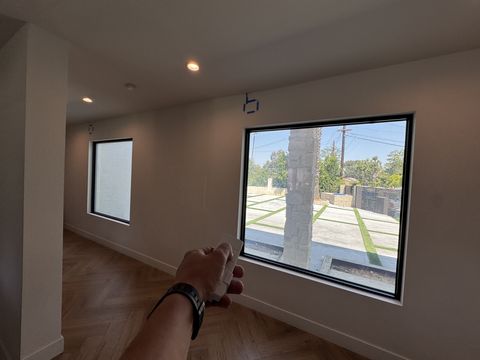
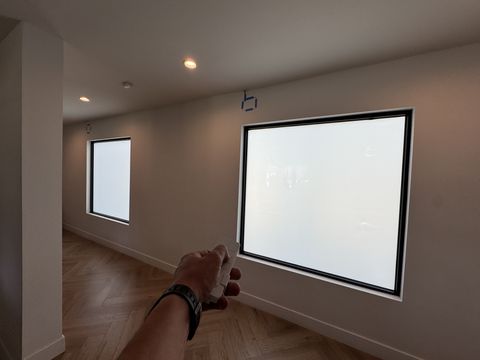
A useful rule of thumb: if your existing window is sound and you mostly want privacy, start with film. If the window is failing, being replaced, or does not exist yet, price the insulated unit.
What people mean by "double layer smart film"
The phrase gets used for three different things, and it helps to know which one you are after before asking for a quote.
- Film for a double-pane window. This is the most common meaning. The answer is yes: the film goes on the inside surface of the inner pane, and the sealed unit is left alone.
- The film's own construction. PDLC film is itself a thin sandwich, a liquid-crystal layer between two conductive sheets. Every piece of switchable film is "double layer" in that sense, so the phrase does not describe a separate product.
- A switchable layer between the two panes. This is what an insulated smart glass unit is. It cannot be added to an existing window afterward, because a sealed unit cannot be opened to slip film between the panes without breaking the seal that makes it insulated. If you want the switch inside the double glazing, the unit has to be built that way.
Wiring, sizes, and lead times for a made-to-order unit
Wiring. The copper busbars are applied and soldered to the smart layer before lamination, and two low-voltage leads exit at the edge of the unit. In our picture windows those leads run inside the frame to one transformer that plugs into a standard wall outlet, and the included wireless remote switches the glass. The system runs at 48 to 65V AC and draws under 5 watts per square meter. Wall switches, schedules, and smart-home systems such as Lutron, Savant, Crestron, and Control4 can drive the same circuit. Each independently switched zone needs its own transformer, so decide early whether a run of windows should switch together or one at a time. The lead position is set at fabrication, which is why we want to know where your power is before anything is built.
Sizes. The switchable laminate is fabricated from 100 x 150 mm up to 1.8 x 3.2 m, in thicknesses from 4+4 mm to 10+10 mm, and can be built with tempered, Low-E, shaped, or hot-bent glass. Picture-window frames are powder-coated to order, with matte black as standard.
Lead times. Nothing here comes off a shelf. Each unit is cut, laminated, wired, and switch-tested at our Canoga Park shop to your dimensions, and an insulated unit takes longer in the shop than a plain laminated panel. We don't publish a stock lead time because we would rather not invent one. You get it in writing with your quote, specific to your sizes and build.
What double-glazed switchable glass costs
There are three price points worth knowing, and they describe different products:
- Complete picture windows (ML76S / ML85S): materials start at $195 per square foot, and every window is custom-quoted by size, frame finish, and glazing configuration.
- Laminated smart glass panels, including insulated builds for another frame: materials start at $100 per square foot, with the final number set by dimensions, glass thickness, and build. Installation is quoted separately once we have seen the glazing details.
- A film retrofit on the window you already have: a single small window usually starts around $1,500 fully installed and scales from there.
Square footage, the number of switching zones, how the wiring reaches the frame, and the control you choose move the final figure. The line-by-line breakdown, including a real itemized estimate, is on our smart glass cost page. Send rough dimensions and a photo of the opening and we will send a free written estimate within one to two business days.
Common questions about insulated smart glass
Is an insulated smart glass unit more energy efficient than film?
Only the factory-built unit carries certified numbers: our ML76S and ML85S picture windows are NFRC-rated at a U-Factor of 0.30 and 0.29 with an SHGC of 0.24. Smart film keeps whatever insulation your existing window already has, and for film we supply manufacturer spec sheets rather than certified ratings.
Can smart film go on my existing double-pane windows?
Yes. The film is bonded to the room-side surface of the inner pane, so a sealed double-pane unit stays sealed and nothing is replaced. Textured or previously tinted glass changes the answer, so send photos first.
How long does an insulated switchable unit take to make?
Every unit is made to order, and an insulated unit is a different shop job from a plain laminated panel, so we don't publish a stock lead time. You get the lead time in writing with your quote, specific to your sizes.
What happens to an insulated smart glass window if the power goes out?
It frosts. The switchable layer is clear only while it is powered, so a power cut leaves the window in its private state while daylight still passes through.
Not sure whether your window needs a new unit or just film? Request a free estimate with a photo and rough sizes, or call (866) 728-9888. Live switching samples are at our Canoga Park showroom, open by appointment.