
Smart Glass for Hospital Conference Rooms

Smart glass for hospital conference rooms gives a glass-walled meeting space privacy on command: switchable PDLC film frosts the wall white at the touch of a button, screening case reviews and family conversations from the corridor — and it defaults to private, not clear, whenever power to the glass is cut.
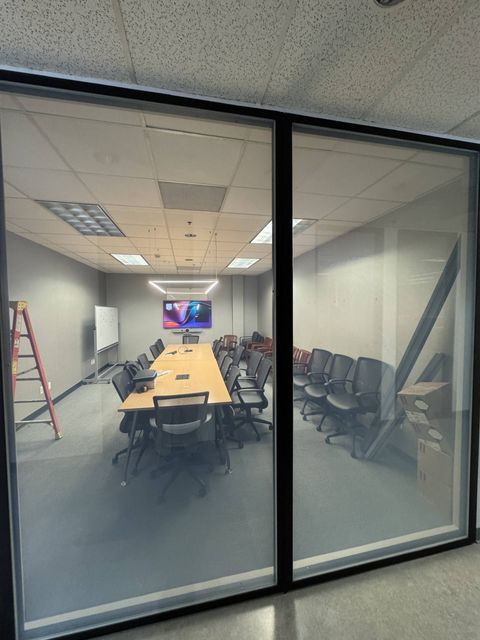
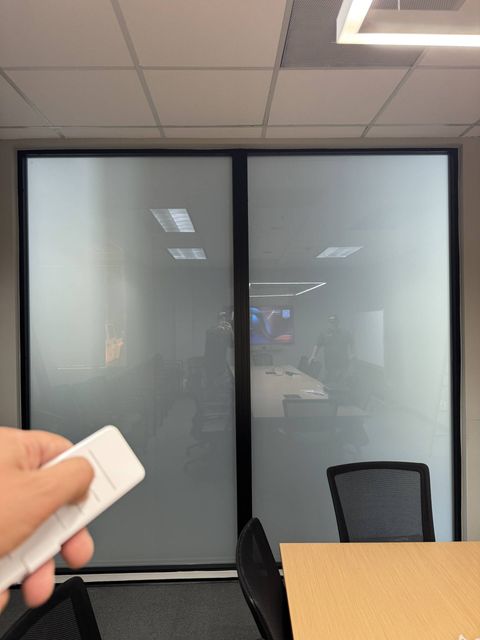
Hospitals adopted glass meeting rooms for the same reasons offices did: daylight, sightlines, and a sense that nothing is hidden. The difference is what happens inside them — and how often the thing on the screen is exactly what nobody in the corridor should see.
Why a glass meeting room carries higher stakes in a hospital
A hospital conference room runs on privacy in a way few commercial spaces do. Morning huddles and case reviews put patient names on a screen. Tumor boards walk through imaging. Family conferences deliver news that deserves a closed door in every sense. All of it happens a pane of glass away from one of the busiest corridors in the building, with staff, patients, and visitors passing all day long.
Blinds and curtains technically answer that — but only when someone remembers to close them, and in a working hospital "someone remembers" is not a privacy policy. A switchable wall moves that decision from habit to hardware: the room is private the instant anyone decides it should be.
How does the frost actually protect the conversation?
The switch is one press — a wall switch by the door, a handheld remote, or a schedule if the facility wants the room private outside meeting hours. The liquid-crystal layer responds in milliseconds, so the whole wall changes state at once, with no fade-through and no patchy corners.
Frosted, the wall is a flat, even white. No outlines, colors, or movement read through it at any normal distance, day or night. And because the frost is translucent rather than dark, the room keeps its daylight — it blocks the view, not the light.
The detail facility teams tend to appreciate most: PDLC film rests frosted when power is removed. A tripped breaker or a failed transformer leaves the room private, not exposed. In a healthcare setting, that fail-safe points in the right direction.
Where switchable glass earns its keep beyond the boardroom
The conference room is usually where the conversation starts, because it is the room with the most glass and the most sensitive traffic. But the same switching layer fits anywhere a sightline needs to be optional rather than permanent:
- Family consult rooms — small rooms where difficult conversations happen feet from a public hallway.
- Telehealth and dictation rooms — screens full of patient information that should never face an open corridor.
- Clinic partitions and observation windows — glass that staff need to see through between appointments and screen during them.
- Administrative boardrooms — peer review, credentialing, and personnel matters carry the same sightline problem without the clinical setting.
A privacy surface you can disinfect
Curtains and fabric blinds are the default privacy layer in most clinical buildings, and they are also the part nobody wants to think about: fabric traps dust, cords collect grime, and neither takes a hospital-grade disinfectant wipe the way a hard surface does. A switchable wall has no fabric and no cords — housekeeping wipes the glass down with the same products used on every other glass surface in the building, and the switching layer inside is unaffected.
Retrofit film or a new switchable panel?
Most hospital conference rooms already have the glass. If those panes are smooth and in good condition, a smart film retrofit adds the switching layer to the wall you own — no demolition and no glazier, with the low-voltage wiring handled by our licensed crew (CA lic. #1134029). For new construction, or a wall being replaced anyway, factory-laminated switchable panels carry the same PDLC layer sealed inside the glass unit, protected from dust and cleaning chemicals. Both forms switch identically, manufacturer spec sheets are available on request, and smart glass installation is planned around the room's calendar rather than the other way around.
What happens when a switchable wall stops switching?
Switchable film routinely outlives its electronics. The transformers that condition power to the glass are the usual failure point, and when they fail the film simply holds one state — which looks like a dead wall but usually is not. That is exactly what we found at a Westlake Village hospital whose conference-room wall had stopped responding: four failed transformers, healthy film, and the original installer long out of the picture. Matched replacement transformers went in during a single service visit, and the room was switching again before staff arrived the next morning.
The point for any facility weighing the upgrade: this is serviceable infrastructure, not a sealed gadget. A system installed today — by us or by someone else — can be diagnosed and repaired locally years later.
What facility teams ask before committing
Does switchable glass make a conference room HIPAA compliant?
No product makes a room compliant by itself — compliance lives in policies and practice. What switchable glass provides is dependable visual privacy: staff can screen a meeting instantly, and the room is private by default whenever the glass is unpowered, which supports the sightline side of those policies far better than blinds someone has to remember to close.
Does the frosted glass block sound as well?
No. The frost removes the view, not the audio — acoustic privacy comes from the wall assembly, door seals, and the construction around the glass. Most glass-walled conference rooms pair the switchable layer with those measures; the glass handles what people can see.
Can film be added to the glass walls we already have?
Usually, yes. Smooth, sound interior glass takes a retrofit film directly, powered by low-voltage wiring that our licensed crew runs discreetly to a switch or relay. Send a few photos and rough dimensions and you will get a straight answer either way.
What does a switchable conference wall cost?
A single small window usually starts around $1,500 fully installed and scales from there with glass area and controls; a full conference wall is priced per project. The estimate is free and remote — photos and dimensions are enough to get real numbers back within one to two business days.
If a meeting room in your building sits one pane of glass away from a busy corridor, the fix is a switch, not a curtain track. Request a free estimate or call Smart View Film Solutions at (866) 728-9888 — send photos and rough dimensions, and you'll have real numbers within one to two business days.