
Electrochromic vs PDLC Smart Glass: Which Wins?

Electrochromic glass vs PDLC smart glass comes down to one question: should the glass go dark, or go private? Electrochromic glass tints like sunglasses over several minutes, taming sun and heat while keeping the view. PDLC smart glass switches from clear to an even white frost in under a second, removing the sightline entirely. One manages sunlight; the other manages privacy.
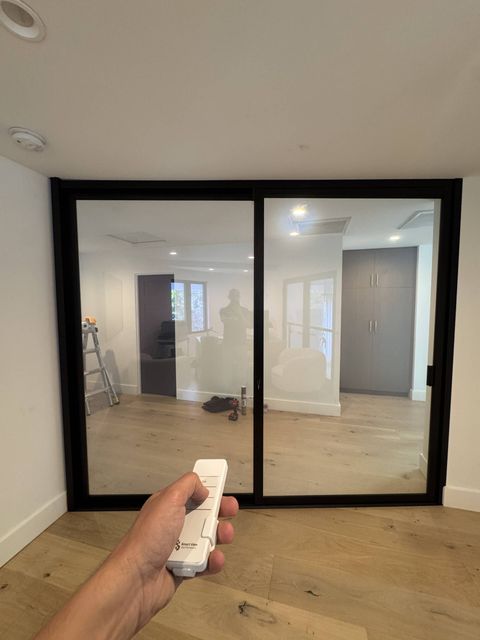
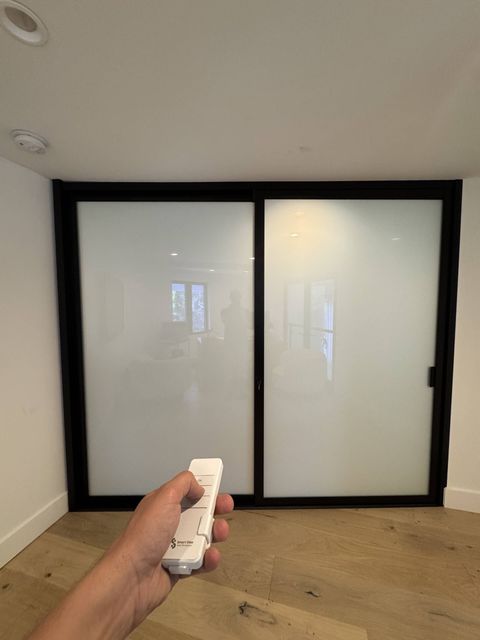
Both technologies are sold under the same “smart glass” label, which is why comparing them gets confusing fast. They share almost nothing beyond the name — different materials, different switching speeds, different budgets, and different jobs. Here is the honest breakdown we walk Los Angeles customers through, including the cases where the product we install is not the right answer.
Two technologies that share one name
Electrochromic glass relies on a metal-oxide coating sealed inside the glass unit. Apply a small voltage and ions migrate through that coating, darkening the pane to a blue-gray tint and holding it there. It is the technology behind self-dimming airplane windows and the tinted curtain walls on newer office towers, and it is engineered around one job: controlling sunlight.
PDLC — polymer dispersed liquid crystal — is the switchable layer inside smart glass panels, and the same layer is available as a retrofit film that bonds to glass you already own. Unpowered, its liquid crystals scatter light and the pane reads as milky white frost. Powered, they align and the pane turns clear. There is no in-between tint and no darkening; it is a privacy switch, not a sunshade.
Does it go dark, or does it go private?
Tinting glass preserves the view. That is its selling point — you still see the skyline while the coating cuts glare and solar heat. But a tinted window is still a window. In the evening, with lights on inside, people outside can see in just as they can through any tinted glass. It is a solar product, not a privacy product.
Switchable frost is the reverse. The white state is a true visual barrier day and night — no readable silhouettes in either direction. It softens harsh light by diffusing it, but it does not meaningfully change how much heat comes through the pane. If your problem is a west-facing wall of afternoon sun, frost alone is the wrong prescription. If your problem is who can see into the room, frost is exactly the prescription.
Switching speed, and what happens when the power goes out
An electrochromic pane takes several minutes to reach full tint, which is fine for a facade tracking the sun across a day. PDLC switches in well under a second from a wall switch, a remote, or a schedule — instant enough to frost a partition mid-meeting or a bathroom window mid-shower.
The resting states differ too, and it matters more than it sounds. Most tinting glass rests clear and darkens on command. PDLC rests frosted: cut the power and the glass settles private, not exposed. For bathrooms, bedrooms, and conference rooms, that fail-safe direction is usually the one you want.
What each one costs in practice
Electrochromic glass is a premium architectural product. It arrives sealed inside new insulated glazing units, is almost always specified into new construction or a full glass replacement, and is quoted per project at commercial-scale budgets. That is why you see it on office towers and museum skylights far more often than on houses.
PDLC is the accessible option, because it retrofits. PDLC smart film bonds to the pane already in your frame — no demolition, no new glazing — and a single small window usually starts around $1,500 fully installed, scaling with glass area and controls. Our smart glass cost guide breaks down what moves the number. For new construction, laminated switchable panels install like standard glass units.
Which one belongs in a home or office?
Search interest says plenty of people are weighing electrochromic glass for a house. In practice, residential electrochromic is rare — a skylight or a high-end window package here and there — while nearly every homeowner and office manager who calls us actually wants privacy on demand. That is a PDLC job.
The smart glass home office in Huntington Beach is a typical example: a sliding glass partition that stays clear and open all day, then frosts from the remote the moment a video call starts. Our crew (CA license #1134029) installed and wired it in a day, with the low-voltage connections hidden in the frame.
And when the fit runs the other way, we say so. If your real problem is solar heat on a large exposure and privacy never enters the conversation, tinting glass or plain shading is the better tool — an honest vendor should route you there rather than sell you frost.
Quick answers before you choose
Is electrochromic glass the same as smart glass?
Both get called smart glass, which causes the confusion. Electrochromic is the tinting kind — it darkens gradually to manage sun while keeping the view. PDLC is the privacy kind — it frosts white instantly. When people picture glass that goes private at the flip of a switch, they are picturing PDLC.
Can electrochromic glass make a room private at night?
No. Even at full tint it stays see-through, and at night the lit interior is more visible than the dark street outside. Privacy takes frost: PDLC's white state blocks the sightline completely in both directions, day or night.
Can either one be added to windows I already have?
Electrochromic generally can't — it comes sealed inside a new glazing unit, so it means replacing the glass. PDLC goes both ways: laminated panels for new glass, or retrofit film bonded to the pane already in your frame, which is how most of our Los Angeles installs are done.
Is smart glass energy efficient?
It depends on the type. Electrochromic glass is built for solar control, tinting to cut heat and glare on sun-facing facades. Switchable privacy glass is not a heat-rejection product; its efficiency is that it gives privacy while daylight keeps coming in, so the lamps stay off, and it draws little power while clear and none while frosted. Certified thermal ratings belong only to our NFRC-rated smart glass picture windows.
How much does PDLC smart glass cost?
A single small window usually starts around $1,500 fully installed and scales with glass area, panel count, and controls. Send photos and rough dimensions to Smart View Film Solutions at (866) 728-9888 and you'll have real numbers within one to two business days.
Still weighing tint against frost for a specific room? Send a few photos and rough dimensions — request your free estimate or call (866) 728-9888 — and you'll get straight answers, and real numbers, within one to two business days.