
Can Smart Film Be Cut to Any Size or Shape?

Can smart film be cut to any size or shape? Very nearly. Every piece is made to measure — cut from the sheet to an opening's exact dimensions, including shapes that aren't rectangles, then wired and sealed before it reaches the job. The real limits: a finished piece can't be trimmed on site, and a single sheet has a maximum width.
People usually ask because their glass is unusual: a transom over a door, a triangle under a gable, a porthole. The shape is rarely what stops a project. Here is how the material is sized, where the real constraints sit, and what you cannot ask the frost to do.
Made to measure, not off the roll
Switchable film arrives as a large sheet and leaves the fabricator as a piece built for one specific opening. Your glass is measured, the piece is cut to those dimensions, a bus bar is bonded along an edge to carry current into the conductive layers, and the edges are sealed. That piece is then matched to a transformer sized for its area and to whatever control you have chosen.
Which is why none of it is bought by the yard. Two windows of the same rough size in one room still get their own measurements, because frames are rarely as square as they look. It also means small glass is completely normal — a narrow transom is no harder to make than a partition, and retrofit smart film bonds to the pane you already own rather than requiring new glass.
What happens when the glass isn't a rectangle?
Shapes that aren't rectangles come out of the same sheet, so an arched top, an angled gable end, or a circle is a cutting problem rather than a product problem. What changes is where the wiring goes: the bus bar needs a straight enough run to sit on and a path back to the transformer that trim can hide, so the sill, head, or a stile gets chosen early rather than late.
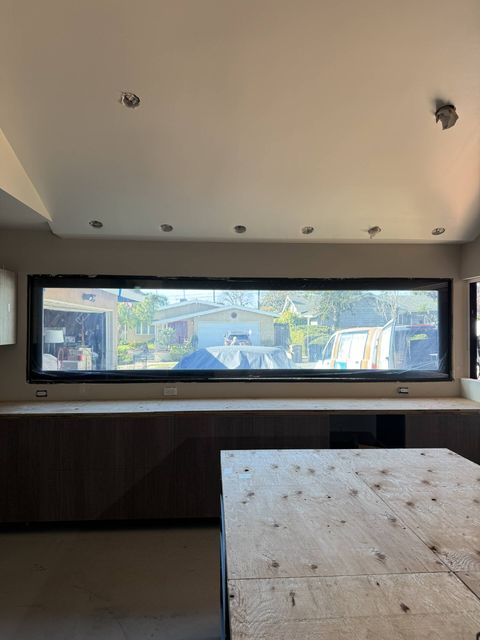
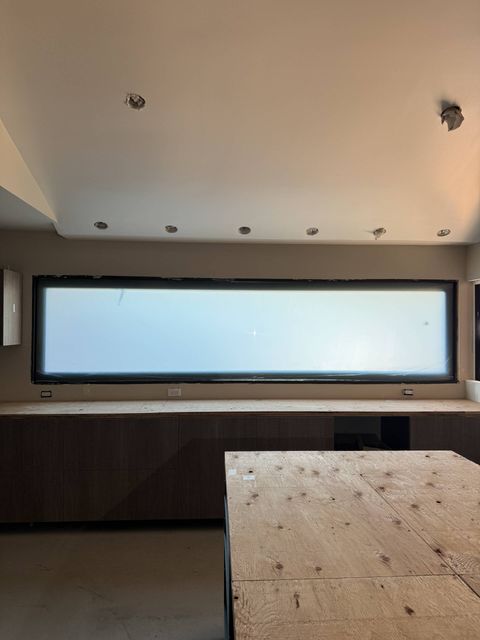
Proportion matters more than geometry. The Seal Beach kitchen above is our clearest example — a letterbox window running the full width of the wall above the cabinets, facing the street, at exactly the height someone stands and works. Blinds don't hang correctly across a band like that, and permanent frosting would have wasted the daylight the design was built around. One made-to-measure piece did fit, because it was cut for that window and nothing else.
The dimension worth raising early is width. A sheet has a maximum, so wider glass is covered by more than one piece, with the join lined up on a mullion or a sightline so it reads as architecture rather than repair. Panel-by-panel specifics come off the manufacturer spec sheets, available on request.
Why a finished piece can't be trimmed on site
Once the bus bar is attached and the edges are sealed, the piece is done. Cutting it down severs the electrical path into the conductive layers and opens the sealed edge, so an oversized piece cannot be shaved to fit the way ordinary sheet goods can — it goes back to be remade. That is the honest reason installers make such a production of measuring.
It also shapes how a project starts. We ask for photographs and rough dimensions up front so the quote reflects your actual openings, and the precise measuring that the cut is based on happens on site, as part of the job itself, carried out by our licensed crew (CA lic. #1134029). Budget scales the way the glass does: a single small window usually starts around $1,500 fully installed and rises with area, piece count, and controls, and the smart glass cost page walks through where the money goes.
Can you get patterns, borders, or a gradient?
Not within a single piece. Cut the power and the whole piece frosts to one flat, even white, edge to edge — we don't build fades, part-shading, or a logo held clear in the middle. Switchable material as we install it is a two-state privacy layer, not a printed graphic and not a dimmer.
You can still design with it, by shaping the film instead of the frost. A band across the lower half of a tall window frosts only that half and leaves the top clear for sky. And a shaped piece — a circle, a stripe, an arc — frosts as that shape against untouched glass around it. Those effects come from where the material is placed, decided before anything is cut.
One more expectation worth setting: the frost is translucent white, so it removes the view while keeping the daylight. It is privacy, not blackout, and no amount of custom shaping changes that.
Questions about sizing switchable film
Can smart film go on an arched or round window?
Yes — curved and angled openings are cut from the same sheet as rectangular ones. The detail to settle early is where the bus bar and its wiring sit, since an irregular frame offers fewer straight runs to hide them in. Send a photo and we will tell you where the wiring would go.
Is there a minimum size worth doing?
No practical minimum. Transoms, sidelights, portholes, and cabinet glass are all normal jobs, and small openings are often the cheapest place to try switchable privacy in a house. Each still needs its own measurement and a transformer, which is why very small pieces don't get proportionally cheaper.
Can one wide window be covered without a visible seam?
Up to the maximum width of a single sheet, yes — one piece, no join. Wider glass takes two or more pieces, and the join is findable up close. We place it on a mullion or an existing sightline so it reads as intentional from across the room.
How do I get a quote for an unusual opening?
Photographs and rough dimensions are enough to start — the estimate is free and handled remotely. Send them to Smart View Film Solutions and you will have real numbers within one to two business days, including a straight answer if we think the opening is a poor fit.
If your glass is an odd shape, an awkward proportion, or simply not a size anything off the shelf covers, that is the normal case rather than the difficult one. Request a free estimate or call Smart View Film Solutions at (866) 728-9888, and you'll have real numbers within one to two business days.