
Smart Glass ROI for 2026: 7 Real Wins on Property Value

Switchable smart glass spec earns its keep on more than the lifestyle layer — on the right LA property, the spec contributes measurable resale value, faster lease-up, lower operating costs, and ESG documentation that increasingly matters to institutional buyers. Smart glass ROI for 2026 isn’t a single metric; it’s the seven wins below compounding across the property’s hold period, and on most LA luxury-residential and Class A commercial projects we ship, the math clears the spec cost before the property changes hands.
This guide walks the seven ROI wins we run on every consult that includes property-value or lifecycle-economics framing. Each comes from real LA-area installs — luxury residential, Class A commercial, mid-size creative office — and the property-manager and luxury-broker conversations that surface during the consult.
Why ROI Reframes the Spec Decision
Five years ago, switchable glass was framed as a lifestyle upgrade — privacy on demand, design-forward aesthetic. Today the conversation increasingly includes ROI, lifecycle math, and connected-home spec premium. Buyers and lenders ask different questions, and the seven wins below answer them. The full calculation is the synthesis of all seven, not any single line item — but the cumulative story consistently clears the spec cost on properties where the wins compound.
The 7 Real Wins
- 1. Resale value premium on luxury residential. LA luxury buyers increasingly screen for connected-home spec across all major systems — switchable glass reads as part of the expected stack alongside Lutron, Savant, integrated audio, and smart climate. Comparable homes without the spec read as dated. Resale premium typically runs $15,000–40,000 on a $2M–5M property, well above install cost on a multi-room residence.
- 2. Faster lease-up on Class A commercial. “Switchable privacy on every conference room” is a legitimate amenity claim that supports rent-per-square-foot targets. Class A buildings running switchable spec across conference rings see measurably faster lease-up vs comparable non-spec’d buildings — typically 15–30 days faster on a typical Class A office floor.
- 3. Tenant retention and renewal rate improvement. Switchable privacy is a quiet but consistent positive on tenant satisfaction surveys. Buildings retaining tenants 12–18 months longer than market average due to quality-of-life spec compound the return across multiple lease cycles.
- 4. Maintenance line-item elimination. Quality switchable spec lasts 10+ years with no recurring replacement. Replaces 2–3 cycles of blinds, curtains, vinyl, and motorized treatments across a 10-year hold. Annual maintenance avoidance runs $4,500–7,500 on a typical mid-size commercial building, $400–800 on a multi-bathroom residence.
- 5. HVAC sizing predictability and energy savings. Certified U-Factor and SHGC numbers — published for Smart View’s NFRC-rated smart glass picture windows, with manufacturer spec sheets covering the film formats — let mechanical engineers size HVAC capacity around known specs — better-sized equipment runs at higher efficiency over service life, and switchable solar-gain reduction lowers cooling load on west-facing glazing. Typical residential energy savings $200–500/year; commercial $2,000–5,000/year on building-wide install.
- 6. ESG and sustainability reporting alignment. The ROI story in 2026 increasingly includes ESG documentation — switchable spec reduces tenant supplemental-lighting reliance, lowers energy use, and contributes to building energy ratings. Increasingly relevant for institutional building owners with reporting obligations to investors and lenders, and for residential buyers in environmentally-aware luxury markets.
- 7. Connected-home spec contribution to insurance and lender views. Premium-spec’d properties with documented connected-home features increasingly receive favorable insurance terms and lender appraisals. Switchable glass contributes to that documented spec stack alongside smart security, smart climate, and integrated automation. The win is modest in isolation but real in aggregate across the property’s hold.
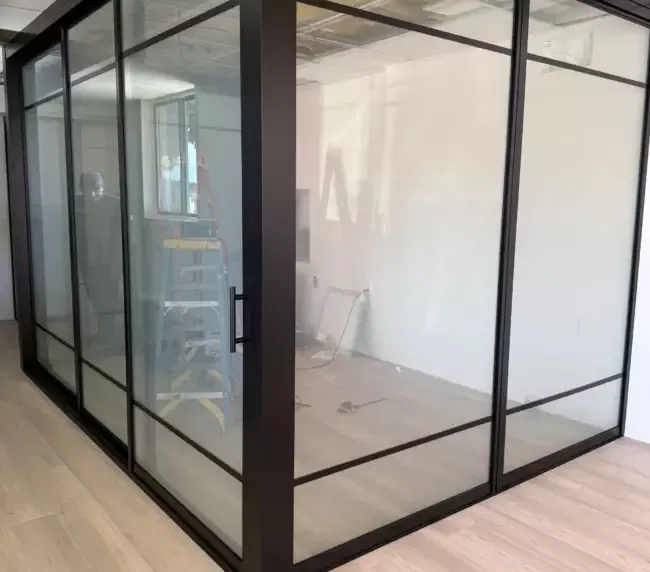
For broader context on what a credible smart glass company looks like at the institutional level — the team experience, install discipline, and warranty stance that lenders and insurance carriers increasingly want to see in connected-home spec documentation — see our smart glass company page.
Where It Pays Back Most Clearly
Across the LA-area installs we ship, the ROI calculation lands strongest on three property types:
- Class A office buildings with high tenant turnover. Wins #2 (lease-up speed), #3 (retention), and #4 (maintenance elimination) compound across 5-year holds. The recurring alternative-treatment cost dominates the math; switchable spec eliminates the line item.
- LA luxury residential ($2M+) on the modern, mid-century, or contemporary architectural axis. Win #1 (resale premium) and win #7 (connected-home spec) compound on the resale story. Luxury buyers in 2026 expect the spec; comparable homes without it read as dated.
- Mid-size creative offices in renovated industrial buildings. Wins #2 (amenity upgrade lease-up) and #5 (HVAC predictability) compound — the spec supports the rent-per-square-foot story while delivering operational savings to the property owner.
How the Seven Wins Compound Across a Property’s Hold Period
None of the seven wins is decisive in isolation. The ROI case is the cumulative story across a 5–10 year hold. A typical Class A office building running switchable spec across 30+ partitions might see win #2 (faster lease-up) on year 1, win #3 (retention) compounding through year 5, win #4 (maintenance avoidance) every year through year 10, and win #6 (ESG reporting) supporting the building’s institutional valuation throughout. Each win is modest; the cumulative impact is meaningful.
For LA luxury residential, the timeline is similar but the wins are weighted toward resale (win #1) and connected-home spec (win #7) at the back end of the hold. Maintenance avoidance and lifestyle wins compound throughout. The cumulative return typically clears the spec cost by year 6–8 of ownership.
The ROI in Real Project Math
For a typical LA luxury residential whole-home install (spec cost quoted after measurement), the resale premium alone (win #1, $15,000–40,000) typically clears the install cost by the time the home changes hands — even without counting maintenance avoidance, energy savings, and lifestyle value across the ownership horizon.
For a mid-size Class A office building (spec cost quoted after measurement, building-wide), win #4 (maintenance avoidance, $4,500–7,500/year) plus win #2 (faster lease-up, equivalent to 0.5–1 month additional rent on a typical floor) typically clear the install cost by year 7–9 of the hold, with wins #3, #5, and #6 contributing additional return throughout.
A Beverly Hills Conference-Room Reference
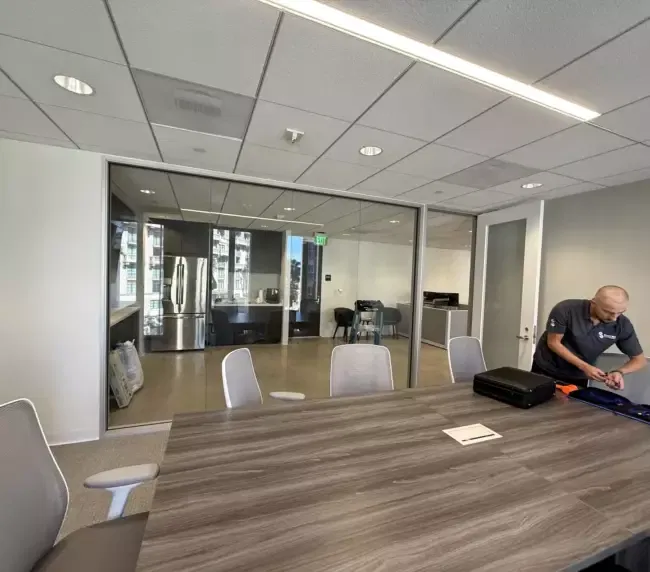
For a concrete example of these wins surfacing in a single project’s economics, our Beverly Hills conference-room install hits four of the seven directly. Faster lease-up support during the building’s tenant-improvement phase (win #2), maintenance line-item elimination across the prior tenant’s blinds-and-vinyl spec (win #4), HVAC sizing benefits from documented thermal performance (win #5), and tenant-satisfaction documentation on subsequent lease renewals (win #3) — all on a unified Crestron-controlled deployment.
Full project breakdown: smart glass conference rooms in Beverly Hills — Class A office implementation with multi-win ROI surfacing.
Planning a Property-Value Smart Glass Spec?
Outside the LA metro? We supply film and glass materials per project and guide your licensed installer on the spec. Get in touch through the contact page with your dimensions and we will confirm what fits and what it costs.