
Smart Glass for Dental and Exam Room Privacy: Private in the Chair, Open Between Patients

Smart glass gives a dental operatory or a medical exam room privacy the instant a patient sits down: the glass wall or window stays clear between patients, then switches to a flat, even white frost on one touch. No blinds to wipe down, no curtains to launder — and it defaults to private whenever the power is off.
Practices choosing smart glass for dental and exam room privacy are usually solving one of two problems: an open-bay operatory where a reclined patient looks straight across at the next chair, or a ground-floor exam room whose window faces a parking lot or walkway. Switchable PDLC glass fixes both without shutting out daylight. Here is how it behaves during patient care, what a real medical install looks like, and what it costs.
The privacy problem an operatory can't blind its way out of
Dental and medical rooms concentrate privacy problems that curtains and blinds handle badly. Open-bay dental clinics line several operatories along one glass-walled corridor, so a patient reclined in one chair looks straight across at the next. Ground-floor exam rooms put a window a few feet from a parking lot, a walkway, or the building next door. And the same daylight that makes a treatment room feel calm is exactly what a blind has to kill to give privacy.
The usual fixes fight a clinical space. Fabric blinds and curtains trap dust and can't take a hospital-grade disinfectant wipe. Frosted vinyl is privacy you can never switch off — a permanently blanked window does nothing for a room that also wants a view of the courtyard between patients. Motorized shades add one more motor to maintain in a room already crowded with equipment.
How does switchable glass behave during patient care?
The glass carries a PDLC (polymer-dispersed liquid crystal) layer. Powered, the crystals align and the pane reads crystal clear; cut the power and it returns to a flat, even milky-white frost. The change takes under a second, so a provider can frost the room as the patient reclines and clear it again the moment the chair is empty. Because frost is the unpowered state, a tripped breaker leaves the room private, not exposed — the behavior a confidentiality-sensitive space wants by default.
Two details matter in a treatment room. The frosted state is translucent, not dark: it diffuses daylight instead of blocking it, so the room stays bright while the sightline disappears. And the surface is sealed glass — it wipes down with the same disinfectants already on the operatory cart, with no fabric or slats to harbor anything.
Operatory walls, exam-room windows, and consult glass
The same switchable layer solves several rooms at once. On interior operatory partitions and glass-walled corridors, it gives chairside privacy on demand while staff keep at-a-glance room status when the glass is clear. On exterior exam-room and consult windows, it blocks the parking-lot or walkway sightline without losing the daylight. On front-desk and check-in glass, it lets staff hold a confidential conversation in private, then clear again for the next patient.
What a real medical install looks like
The pair below is a real Smart View install at a Beverly Hills surgery clinic, photographed on one switch. Clear, the glass reads as an open, modern suite; frosted, the room disappears behind an even white wall.
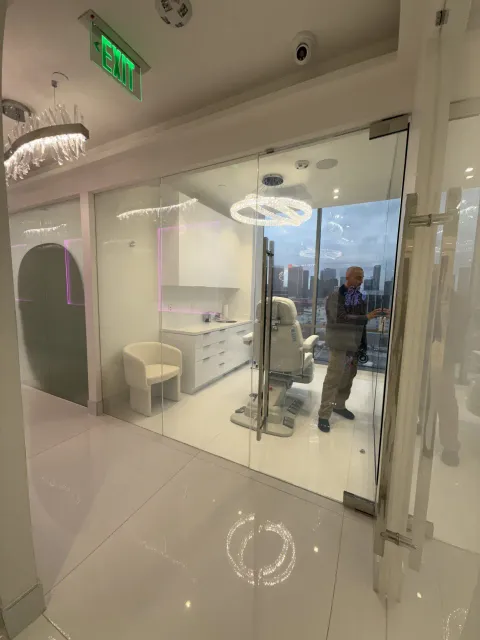
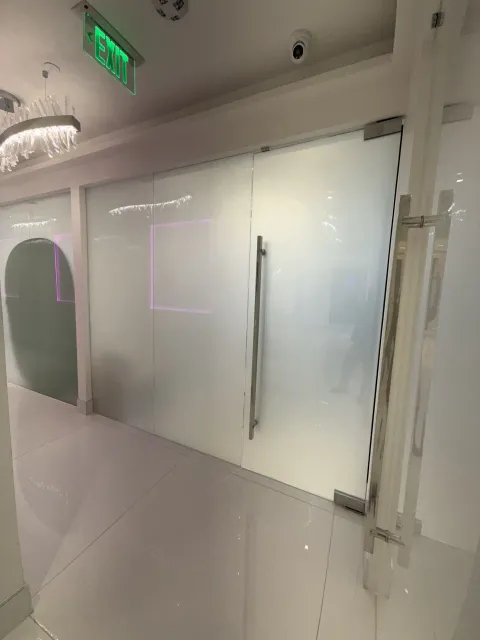
The full write-up — procedure-suite and consult-room glass on a working medical practice — is in our smart glass surgery clinic in Beverly Hills. The same spec covers a dental operatory or a single exam-room window.
Adding it without shutting the practice
There are two routes in. If your rooms are already glass-walled or have glass doors, smart film retrofits onto the interior face of the glass you own — panels arrive pre-cut with the electrical connections factory-applied, and the low-voltage wiring hides in the frame. No demolition, no replacing the glazing. For a new build-out or remodel, the same switchable layer comes laminated inside new glass instead. Either way the work schedules around patient hours — most single-room projects fit an evening or a dark day. The full service is on our smart film installation in Los Angeles page; we travel to larger medical projects within driving range of LA and supply material-only orders per project to your installer, with a wiring guide.
What dental and exam-room glass costs
Pricing scales with glass area and the controls you choose. A single small window usually starts around $1,500 fully installed and climbs from there — one exam-room window sits at the lower end, a row of operatory partitions scales with the square footage. The honest breakdown of what drives the number, film versus new glass, lives on our smart glass cost page. Quoting is remote: send photos and rough dimensions of the rooms, and you'll have real numbers within one to two business days — no site visit needed to get a price.
Questions dental and medical practices ask
Can the glass be wiped down with clinical disinfectants?
Yes. The switchable layer is sealed inside or behind glass, so the surface you clean is ordinary glass — it takes the alcohol- and quaternary-ammonium wipes already used on operatory surfaces without degrading the film.
Does frosting the room make it too dark to work in?
No. The frost is a translucent white that diffuses daylight rather than blocking it, so overhead and task lighting stay effective. It removes the sightline, not the light.
Can we retrofit the operatories we already have?
Almost always. Smart film bonds to the interior face of existing glass walls, partitions, and windows with no demolition. Heavily tinted or already-treated glass is evaluated case by case before we quote.
The switch is the part a photo can't sell — a glass wall snapping from clear to a perfect frost as the patient sits down. Request your estimate or call (866) 728-9888 with photos and rough sizes of the rooms, and we'll send real numbers within one to two business days.