
Smart Film Privacy Mistakes: 7 Top Fixes (2026)

Switchable smart film delivers privacy-on-demand cleanly when it’s spec’d and installed correctly. When it’s not, the same seven mistakes show up across nearly every botched install we get called in to fix. Most are preventable with a 30-minute spec review before glass gets ordered.
This guide catalogs the smart film privacy mistakes we see most often on LA-area residential and commercial projects, with the fix for each. Every mistake comes from a real install we either prevented or rescued in the last 12 months.
The Pattern Behind Nearly Every Botched Install
The mistakes cluster into two categories: treating switchable film as a standalone product (ignoring control integration, HVAC coordination, or acoustic pairing) and under-spec’ing the install (skipping site measure rigor, glass prep, or the default-state-frosted briefing). Almost every smart film privacy mistake we fix lives inside one of those two buckets.
Below: the seven we flag every time, with the switchable-film fix for each.
Mistake #1 — Skipping the Control-Path Decision Before Site Measure
The problem. Buyers spec the film without picking the control path (wall switch / remote / smartphone app / smart-home integration). Site measure ends without a control plan; install day forces reactive wiring that costs more or compromises on integration.
The fix. Decide the control path during the consult, before site measure. The electrician pulls the right cable on the first visit. Smart-home integration (Lutron, Savant, voice assistants) is significantly cheaper to plan up front than to retrofit after install.
Mistake #2 — Choosing Cheap Amazon Switchable-Film Kits
The problem. Buyers under cost pressure pick DIY switchable-film kits from online marketplaces. These fail under sun and HVAC airflow within 12–24 months — yellowed adhesive, delaminated edges, dead spots in the film. Replacement cost erases the original savings.
The fix. Spec professional-grade PDLC switchable film with warranted install and documented lifespan (10+ years). The cost difference is usually under 2× the cheap-kit route; the quality and lifetime difference is 10×.
Mistake #3 — Inadequate Glass Prep Before Film Application
The problem. Installers rush the glass prep step. Dust, residue, or trim caulk anywhere near the install zone causes bubbles or delamination weeks or months later. The film looks clean for 60 days, then problems show up at the edges.
The fix. Plan more time on glass prep than on film application — that ratio surprises most clients but it’s how quality installs ship. Clean-room standards on the interior glass face: alcohol wipe-down, microfiber cloths, controlled environment during application.
Mistake #4 — Not Briefing Users on Default-State-Frosted Behavior
The problem. Switchable film defaults to frosted on power loss (the “normally opaque” state). The first time the power flickers, users who weren’t briefed call facilities or the installer convinced the system is broken. Service ticket is preventable with one paragraph.
The fix. Add a short “your switchable glass behavior” note to the user welcome materials. Most users actually appreciate the default-to-private behavior once it’s explained — it’s a feature, not a bug.
Mistake #5 — Forgetting the Driver Location During Site Measure
The problem. The low-voltage driver has to live somewhere accessible — cabinet, ceiling cavity, utility closet. When the location isn’t planned during site measure, install day involves either an awkward visible driver placement or pulling extra wiring to a remote location.
The fix. Identify the driver location during the site-measure walk-through. Confirm with the homeowner or facilities manager that the chosen location stays accessible long-term.
Mistake #6 — Mixing Switchable Film with Tinted or Treated Glass
The problem. Switchable film bonds best to clean, untreated glass. Existing window tint, sun-control film, or frosted vinyl already in place reduces film performance — the optical effect gets muddy and the install warranty may not cover the result.
The fix. During site measure, confirm the existing glass is untreated. If there’s existing film, plan removal as a separate prep step before switchable-film install (or consider whether a new glass replacement is more sensible than retrofit at that point).
Mistake #7 — Not Considering Acoustic Privacy Alongside Visual
The problem. Switchable film handles visual privacy beautifully but doesn’t add acoustic mass. A bedroom window or conference room that goes frosted but still transmits sound through single-pane glass isn’t actually private — visual privacy without acoustic privacy is a half-solution.
The fix. For rooms that need both, spec laminated or double-pane assemblies with switchable film applied to one face. The lamination adds significant STC (acoustic) performance; the film handles visual. Plan both during the original glazing spec.
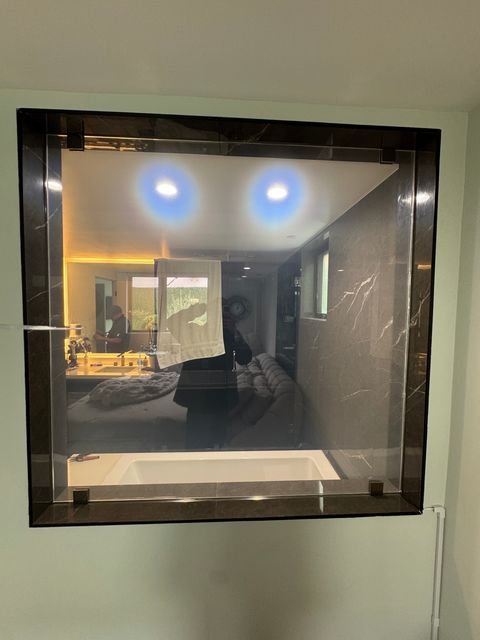
Four More Mistakes Specific to Office Buildouts
On commercial buildouts — conference rooms, executive offices, glass partitions — a few extra spec errors show up alongside the seven above:
Relying on blinds or curtains for “privacy.” Blinds collect dust, break, look residential in a Class A commercial context, and need someone to physically open and close them every transition. Switchable film gives the same privacy-on-demand effect with no mechanical parts — one wall switch or BMS tie-in controls the whole room.
Installing permanent frosted glass instead of switchable. Permanent frost locks the space into a single mode. Conference rooms need to flip between open/collaborative (clear) and focused/private (frosted) throughout a workday — switchable film makes that transition in about one second.
Sacrificing natural light to solve for privacy. Smart film in frosted mode is obscuring, not darkening — light still comes through; sightlines don’t. Daylight is one of the highest-leverage amenity factors in Class A office lease-up, and it survives the privacy fix intact.
Underestimating tenant turnover and HVAC impact. Static treatments get ripped out at every tenant turnover; switchable film is tenant-configurable via a switch or app — one install works for every tenant across the building’s life. And where mechanical load matters, our NFRC-rated smart glass picture windows give HVAC engineers certified U-Factor and SHGC figures to design around.
How One Mistake Becomes Five on Multi-Room Installs
On a single bathroom window, any one of these mistakes is recoverable. On a multi-room residence with bathroom + bedroom + French doors + conference room all on the same project, the same mistake repeated five times becomes a substantial debugging exercise. Most clients only see the pattern after the second or third service call.
On commercial floors the compounding is worse: on a 50,000 sq ft buildout with 30+ glass partitions, small spec errors scale to 10–20× the cost of the original “cheap” decision — and none are hard to avoid if the spec is reviewed before the glass is ordered.
For broader context on how install-side mechanics work across LA-area projects, see our smart film installation overview — covers the install process city by city.
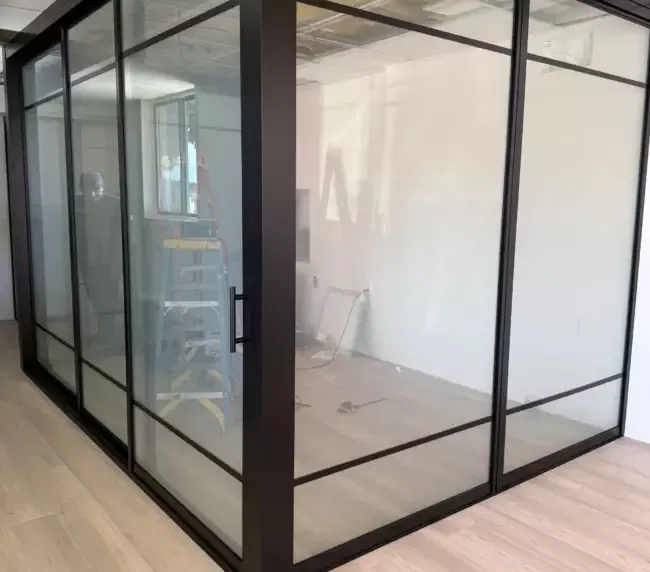
A Pasadena Bathroom Reference
The cleanest example of these mistakes caught and fixed during the consult phase is a Pasadena bathroom-window install we shipped this year. Original buyer plan included a cheap online kit (mistake #2) and no control-path decision (mistake #1). Both caught during the design walk; switched to professional-grade PDLC switchable film with a wall-switch + smartphone app pairing.
Full project breakdown: smart glass on a Pasadena bathroom window — same playbook applied to a single residential scope.
For the commercial equivalent — blinds, single-pane glass, and no HVAC coordination caught in one design review — see our smart glass conference rooms in Beverly Hills install.
Planning a Switchable-Film Install?
If price is what you’re weighing, start on our smart glass cost page for the published per-square-foot numbers. Not ready for a full quote? Send the one thing you are unsure about — glass type, control wiring, timeline — through our contact page or call (866) 728-9888, and we will give you a straight answer.