
Smart Glass for Restaurant Private Dining Rooms: Open Room, Private Table

Smart glass gives a private dining room both things it is supposed to sell: an open, glass-walled space that keeps the energy of the main floor, and real privacy the moment a party wants it. One switch turns the clear walls to a flat, even white frost — no curtains to draw, no partitions to drag, no lost daylight.
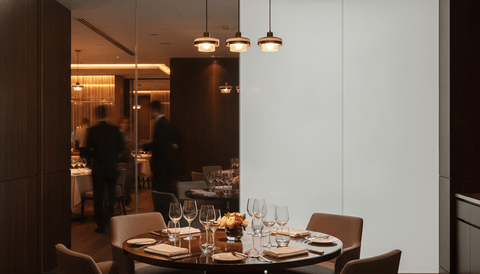
Restaurateurs weighing smart glass for restaurant private dining rooms usually arrive at it from one of two frustrations: a walled-off room nobody books because it feels like exile, or an open alcove big parties skip because it offers no privacy at all. Switchable PDLC glass dissolves that trade-off. Here is how it behaves during service, what a real install looks like, and what it costs.
The trade-off every dining room floor plan fights
A fully walled private room is a hard sell. Guests who came out for a night in your dining room end up in a box that could belong to any hotel; the host can't show the space without walking people away from the atmosphere they came for. Leave the room open instead, and it can't earn its keep — business dinners, celebrations, and buyouts pass on it because every toast and term sheet carries to the next table.
The usual compromises fight the space. Curtains hold odors and read as banquet hall. Movable partitions need storage and staff time between seatings. Etched or vinyl-frosted glass is privacy you can never switch off — on a slow Tuesday, a permanently hidden room does nothing for the floor.
How does switchable glass behave during service?
The glass carries a PDLC (polymer-dispersed liquid crystal) layer. Powered, the crystals align and the pane reads crystal clear; cut the power and it returns to a flat, even milky-white frost. The change takes under a second in both directions — fast enough that the host can frost the room as the party sits down. And because frost is the unpowered state, a tripped breaker leaves the room private, not exposed.
Two details matter for a dining room. The frosted state is a translucent white, not a dark tint — it diffuses the room's light instead of blocking it, so the private room stays bright and the main floor keeps its glow through the glass. And the frosted wall doubles as a clean rear-projection surface: ambient visuals on an ordinary night, a slideshow or brand reel when the room is bought out for an event.
What the switch looks like on a real install
The pair below is a real Smart View install — floor-to-ceiling switchable sliding-glass partitions around a corner room, photographed seconds apart on one switch. Clear, the room reads as part of the floor. Frosted, it disappears completely.
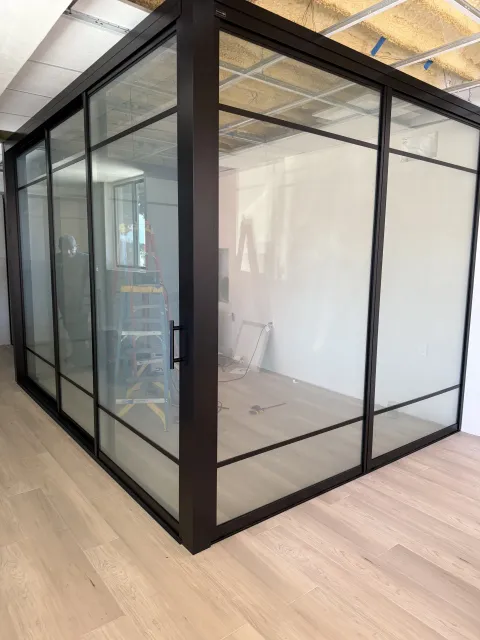
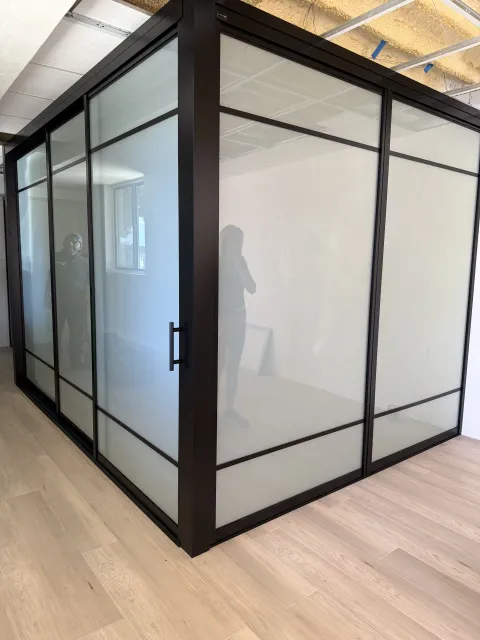
The full write-up lives in our smart glass room dividers project in Santa Barbara — the same partition spec a private dining room uses: full-height glass, slim frames, sliding door panels, one switch per room.
Adding it without closing the dining room
There are two routes in. If your private room already sits behind glass partitions or glass doors, smart film retrofits onto the interior face of the glass you own — the panels arrive pre-cut with the electrical connections factory-applied, and the low-voltage wiring hides in the frames. No demolition, no replacing the glazing. For a remodel or new build-out, the same switchable layer comes laminated inside new glass panels instead.
Either way, the work schedules around service: dark days and morning hours cover most single-room projects, and a typical private dining room is a one-to-two-day install. We fabricate and install across the LA metro — the full service is described on our smart glass installation in Los Angeles page — travel to larger hospitality projects within driving range of LA, and supply material-only orders per project to your installer, with a wiring guide.
What a private dining room costs
Pricing scales with glass area and the controls you choose. A single small pane starts around $1,500 fully installed and climbs with square footage — glassing in three sides of a room is a bigger project than switching one existing partition wall. The honest breakdown of what drives the number, film versus new glass, lives on our smart glass cost page.
Against the revenue math, the spec tends to defend itself: private dining commands minimums and books events the open floor can't, and the glass turns one room into both — showcase when it's empty, private when it's sold. Quoting is remote: send photos and rough dimensions of the room, and you'll have real numbers within one to two business days.
Questions restaurant owners ask
Can we add switchable privacy to the glass partitions we already have?
Almost always. Smart film bonds to the interior face of existing glass partitions and glass doors with no demolition. Heavily tinted or textured glass gets evaluated case by case before we quote.
Does the frosted state block sound as well as sightlines?
It blocks sightlines, not conversations. Full-height glass with a closing door damps typical dining-room noise on its own, but the switchable layer itself is visual privacy — plan acoustics with the glazing assembly and door seals, not the film.
Who controls the glass during service?
Whoever you choose. The standard setup is a wall switch at the room or host stand; remote, phone app, and scheduling are standard options — auto-frost at a set hour, or leave the room clear on slow nights so the space sells itself.
The switch is the part that sells the room — a glass wall snapping from open to private in under a second. Request your estimate or call (866) 728-9888 with photos and rough sizes of the space, and we'll send real numbers within one to two business days.