
Smart Glass for Operable Glass Walls and Partitions

Smart glass for operable glass walls and partitions adds the one state an all-glass design is missing: privacy. A switchable PDLC layer — retrofit film bonded to glass you already own, or panels with the layer laminated inside — turns each pane from clear to an even white frost at a switch, and it works on fixed and sliding panels alike.
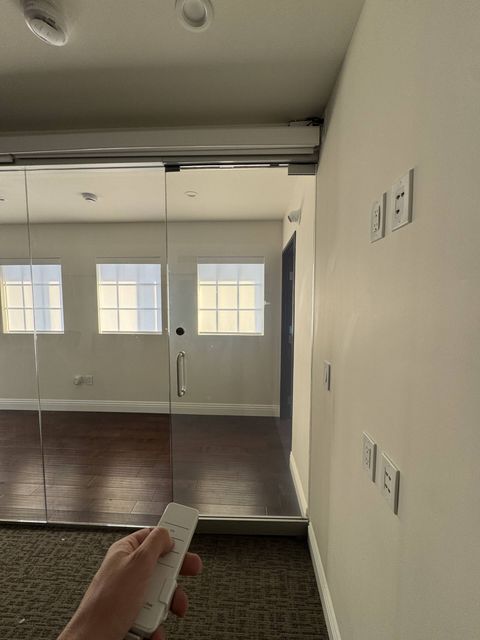
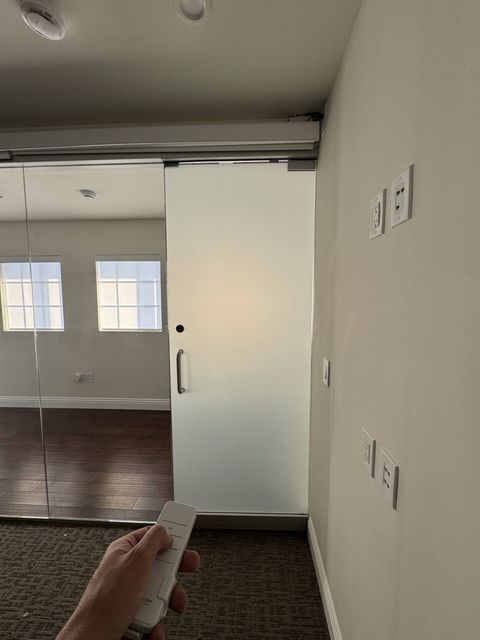
Glass walls earned their place in modern offices and homes by doing two things at once: keeping sightlines open and letting daylight travel through the whole floor. The catch shows up the moment a room needs to be private. Blinds and curtains fight the look the wall was chosen for, and etched frost gives up the openness permanently. A switchable layer keeps both states — and unlike most privacy treatments, it does not care whether the panel it lives on moves.
Where a switchable layer fits in a wall system
Any glazed division of space is a candidate. Conference-room fronts are the classic case — a Beverly Hills boardroom that stays open all day and goes private for one meeting. Corridor-facing partitions in creative offices from Long Beach to downtown Los Angeles get the same treatment, as do treatment rooms and studios in Pasadena where every client walks past one room to reach another. In houses, the same panels divide home offices, gyms, and en-suites without closing them off.
The point is not the room type. It is the pattern: glass that is right most of the day and wrong for twenty minutes at a stretch. That is exactly the gap a switchable layer fills.
Can a sliding or folding panel be switchable?
Yes — and this is the question that stalls most operable-wall projects. The switchable layer itself has no moving parts; it bonds to the glass and travels with it. What has to be engineered is the power path, because every panel needs a low-voltage feed to hold clear. On a top-hung slider like the one pictured above — part of our smart glass office project in Hermosa Beach — the panel frosts from a handheld remote and slides exactly as it did before, with the feed tucked at the header rather than trailing from the glass. Hinged glass doors route power at the pivot edge instead. Large multi-panel stacking walls are quoted case by case, panel travel and parking positions included, so the wiring is decided before anything is fabricated.
Retrofit film or factory-laminated panels?
Most existing partitions take the retrofit route: switchable film is bonded to the dry, room-side face of the glass already in your frames, so the wall you invested in stays put. The application is professional work — clean surface prep and a protected powered edge decide how the film ages — and it is handled end to end by our own licensed crew (CA lic. #1134029); see smart glass installation for how a project runs. Manufacturer spec sheets for the film are available on request.
For brand-new wall systems, and for any panel that lives in moisture or weather, the better build is a switchable glass panel: the same PDLC layer sealed inside laminated glass at the factory, with nothing exposed. Those units drop into a wall system the way any glass panel does, so the glazing side of the project stays standard.
Deciding which panels switch together
Zoning matters more in a wall system than on a single window, because a partition is many panes acting as one surface. A zone is a group of panels that always switch together. A conference front usually wants to be one zone; a run of corridor partitions serving different rooms wants one zone per room; and an operable wall sometimes earns per-panel control, like the Hermosa Beach slider that frosts while its fixed sidelites stay clear. Zones are settled during the estimate, because each zone gets its own transformer circuit — regrouping later means new wiring, not just new settings.
What it costs to make a glass wall switchable
A single small pane usually starts around $1,500 fully installed and scales from there with glass area, panel count, and controls — a full conference front or a multi-panel operable wall is priced per project. The honest way to budget is by the panel: film on glass you already own costs less than replacing that same wall with laminated switchable units, which is why retrofit is where most partition projects land. The smart glass cost page breaks down what moves the number. We install across the LA metro — Long Beach to Pasadena — and travel for larger commercial projects, Palm Springs included.
Questions we hear about switchable partitions
Does daily sliding wear out the switchable layer?
No. The layer bonds to the glass and moves with it — there is nothing mechanical in the film to wear. The part designed for movement is the power connection, which is engineered for the panel's travel, and the glass hardware itself wears no faster than it did before.
Can an existing partition be made switchable without replacing it?
Usually, yes. Retrofit film bonds to the room-side face of the glass already in the frame, so fixed partitions are almost always straightforward. Movable panels get evaluated from photos first so the power path is planned before anything is fabricated.
Do all the panels have to frost at once?
No. Panels are grouped into zones that switch together, and the zones are yours to choose — one room's front can go private while the rest of the run stays clear, or a single sliding panel can switch on its own.
What does a switchable partition cost?
A single small pane usually starts around $1,500 fully installed and scales with glass area, panel count, and controls. Send photos and rough dimensions to Smart View Film Solutions at (866) 728-9888 and you'll have real numbers within one to two business days.
If a glass wall is on your plans — or already standing — the switchable conversation is worth having before the next fit-out decision. Request your free estimate with photos and rough measurements, and we'll come back with panel-by-panel numbers within one to two business days.