Smart Film for Property Managers: 7 Top Plays (2026)
Property managers spec privacy treatments on a different math than residential buyers. The decision isn’t “do I want privacy?” — the decision is “does this treatment hold up across tenant turnover, support amenity claims, fit my BMS standards, and pencil out against alternatives over the building’s lease cycle?” Switchable smart film for property managers wins on all four dimensions, when it’s spec’d correctly.
This guide walks the seven smart film for property managers plays we run on every property-manager consult. Each comes from real Class A and B+ commercial installs we’ve shipped across LA in the last 12 months, and the property-manager conversations that surface most often during the consult.
Why Smart Film for Property Managers Earns the Spec on a Building Math
Three structural advantages make smart film for property managers pencil out cleanly on Class A and B+ assets: it adapts to tenant preference (no rip-and-replace at every turnover), it preserves daylight (a top-three amenity factor in office leasing), and it has documented thermal behavior (HVAC engineers can plan around known specs). Each compounds across the building’s lease cycle, and the seven plays below are the specific ways property managers extract building-level value from a switchable-film install.
The 7 Smart Film for Property Managers Plays
- 1. Tenant retention via privacy flexibility. Different tenants have different privacy preferences — law firms want frost most of the time, design studios want clear with occasional privacy. Smart film for property managers accommodates both without re-spec at turnover. Reduces friction at lease renewal; reduces capex at re-tenant.
- 2. Amenity-package upgrade for new lease-up. Class A and B+ leasing increasingly competes on amenity packages. “Switchable privacy on every conference room” is a legitimate amenity claim that supports the rent-per-square-foot the building targets. Smart film delivers this without the cost of integrated smart glass replacement.
- 3. Reduced fixturing and replacement capex. Blinds break, frosted vinyl peels, drapes need cleaning. Quality smart film for property managers lasts 10+ years with no recurring replacement spend. Single capex line replaces 2–3 cycles of traditional treatment costs over a 10-year hold.
- 4. HVAC sizing predictability. Switchable film publishes documented U-values and SHGC numbers — mechanical engineers can plan thermal load around known specs. No tenant-driven thermal load surprises (the way tenant-installed blinds drift the calc). Cleaner mechanical commissioning on retrofits and new builds.
- 5. Building-wide BMS control via Crestron, Lutron, or Savant. Smart film for property managers integrates cleanly with Crestron, Lutron, Savant, and equivalent BMS platforms. Property managers can implement after-hours global-private modes, scheduled privacy patterns, and tenant-controlled per-room overrides. Standard offering on modern Class A buildings.
- 6. Storefront and ground-floor commercial value. Buildings with ground-floor retail or street-facing commercial benefit from switchable film on storefront glass — clear during business hours (merchandising), frosted after hours (security + reduced smash-and-grab signal). Real building-asset protection that traditional treatments can’t match.
- 7. ESG and sustainability reporting alignment. Switchable film reduces tenant supplemental-lighting reliance during privacy mode (compared to closed blinds), which lowers building energy use and supports ESG reporting. Increasingly relevant for institutional building owners with reporting obligations to investors and lenders.
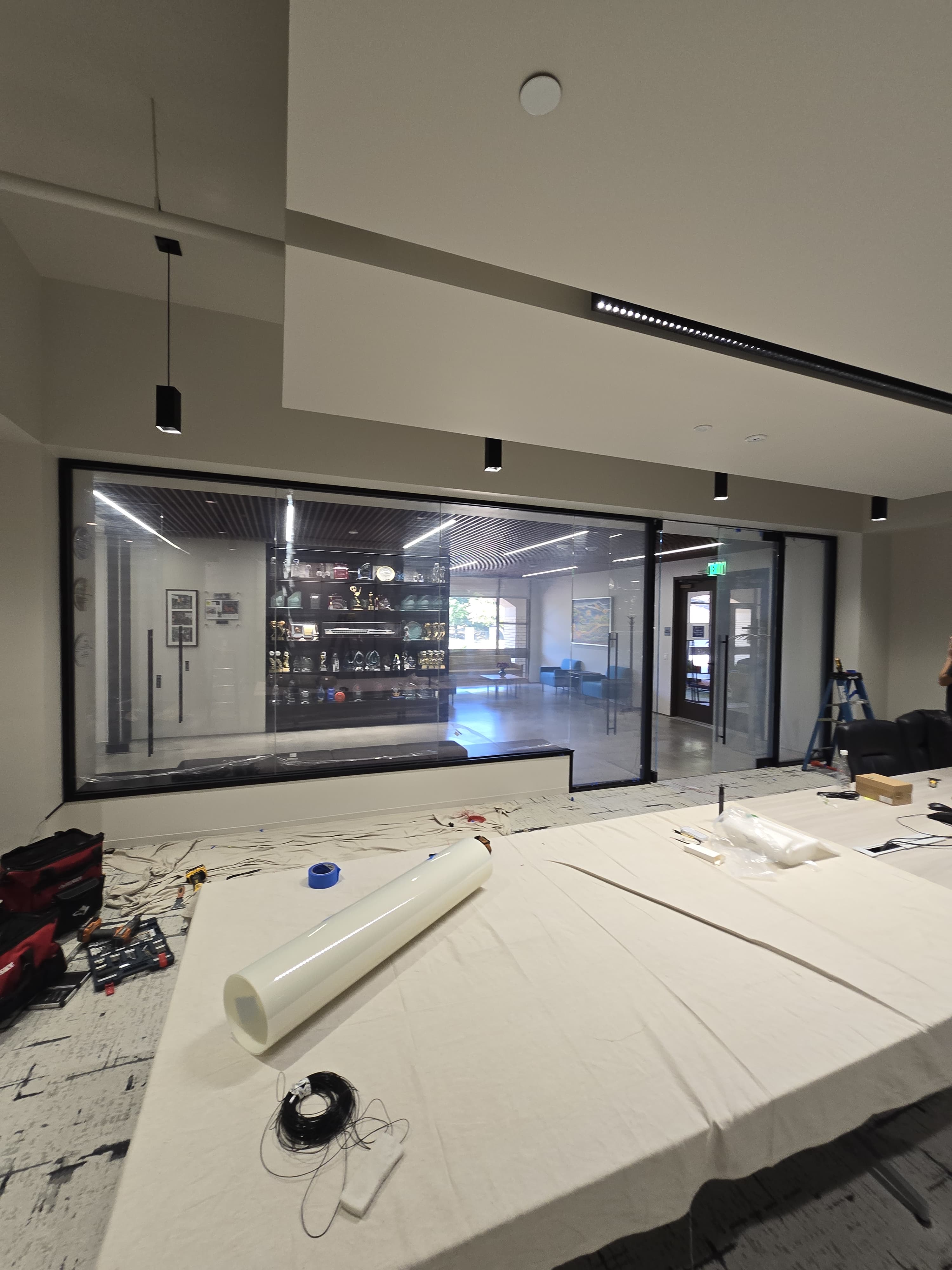
For broader context on what a credible smart film provider looks like at the company level (team experience, install discipline, warranty stance) — particularly relevant when property managers are vetting potential install partners — see our smart glass company page.
Where Smart Film for Property Managers Pays Back Fastest
Across the LA-area commercial installs we ship, the smart film for property managers payback is fastest on three building types:
- Class A office with high tenant turnover — plays #1 (retention) and #3 (replacement capex) compound across 5-year holds. The recurring alternative-treatment cost dominates the math; switchable spec eliminates the line item.
- Mid-size creative offices in renovated industrial buildings — play #2 (amenity upgrade) plus play #5 (BMS control) define the lease-up advantage. DTLA, Culver City, and Silver Lake creative-office stock specifically responds to the switchable-spec story during lease-up tours.
- Mixed-use buildings with ground-floor retail — play #6 (storefront value) plus play #2 (amenity upgrade) work together to support the building’s blended-use revenue model.
How Smart Film for Property Managers Plays Compound Across a Lease Cycle
Property managers think about treatments in lease cycles, not in months. A typical Class A office building running smart film for property managers across 30+ glass partitions sees three compounding effects over a 5-year lease:
- Tenant satisfaction scores rise — switchable privacy is a quiet but consistent positive on tenant surveys (per the property managers we work with).
- Service ticket count drops — no recurring blinds-broken or vinyl-peeling tickets across 30+ partitions.
- Re-tenant capex compresses — privacy treatment doesn’t get rebuilt at every turnover; the next tenant inherits the working system.
None of these are headline-grabbing wins. They compound quietly across the building’s hold period, and they show up most clearly in the year-over-year facilities budget. Play #3 alone often pays for the spec across the lease cycle.
Smart Film for Property Managers in Real Project Math
For a typical mid-size LA Class A office building (50,000–100,000 sq ft, 30+ glass partitions across conference rooms, executive suites, HR rooms, and amenity spaces), smart film for property managers spec runs roughly $80,000–140,000 installed building-wide. Spread across a 10-year hold that’s $8,000–14,000 per year — comfortably below the $12,000–18,000 per year that recurring blinds, vinyl, and curtain replacement costs would otherwise require across the same surface count.
For a property manager spec’ing across a multi-building portfolio, the per-building economics improve as the install scales — the installer learns the building’s spec preferences on the first project; subsequent buildings ship faster and cleaner because the relationship is already calibrated.
A Reseda Storefront Reference
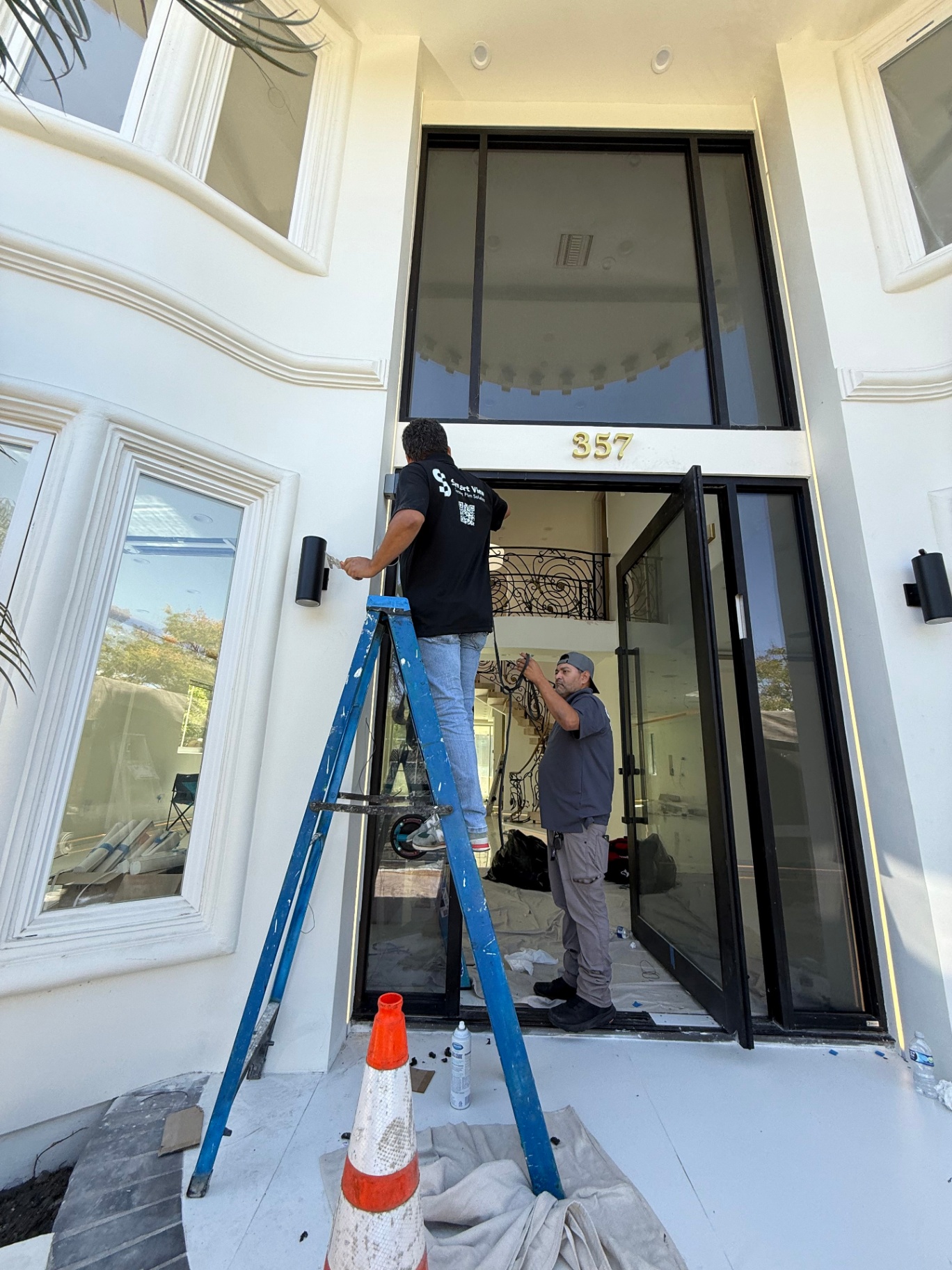
The cleanest example of smart film for property managers delivering on the seven plays above is a Reseda storefront install we shipped this year. Existing commercial glass on a high-traffic facade; spec ran clear-mode during business hours and frosted-mode after hours, with the switchable circuit tied to the building closing routine. Plays #6 (storefront value), #5 (BMS-style scheduled control), and #3 (replacement capex avoidance) all surfaced in the project economics.
Full project breakdown: smart glass storefront in Reseda — single retail scope, full property-manager-plays playbook applied.
Planning a Property-Manager Smart Film Spec?
If you’re a property manager spec’ing privacy on a new buildout, tenant-improvement, or building-wide upgrade, a 30-minute spec review can identify which of the seven smart film for property managers plays apply most to your specific asset before glass is ordered. No sales pressure — straight read on which plays drive the strongest payback for your portfolio.
Contact Smart View with the building type, total glass square footage, your tenant mix, and your BMS standard, and we’ll outline which plays are most relevant to your scope.