
What to Know Before Buying PDLC Smart Film (2026)

PDLC smart film (Polymer Dispersed Liquid Crystal) is a switchable film that turns glass from clear to frosted in under a second: liquid-crystal droplets inside the film line up when powered to go transparent, and scatter light the moment power drops for instant privacy. If you’re buying it for a commercial office, executive suite, or luxury residential upgrade, this guide compiles every spec, electrical requirement, UV and IR metric, and installation constraint — so you can size the project intelligently before you sign anything.
At Smart View Film Solutions, we retrofit PDLC switchable glass across Southern California every week, and the numbers below reflect what we actually see in the field, not brochure copy. Use this as a reference when you’re evaluating quotes from any installer. When you’re ready to price a specific opening, our smart glass cost guide covers the budget side, and the PDLC smart film page covers the retrofit product itself.
The specs at a glance
Before diving into the mechanics, here are the numbers most buyers need to nail down before committing to a project:
- UV blocking: 99% (in both clear and opaque states)
- Visible light transmission (opaque mode): 70–80% ambient light still passes through
- Operating voltage: 60V AC (never DC)
- Power consumption: ~5 W per square meter when clear; 0 W when opaque
- Haze rating (clear state): 3–5% on quality PDLC film
- Switch time: milliseconds (essentially instant)
- Lifespan: 80,000+ hours in the ON state (~9+ years continuous)
- Install type: retrofit (smart film) or factory-laminated (smart glass)
How does PDLC technology actually work?
At its core, PDLC (Polymer Dispersed Liquid Crystal) relies on controlling light through liquid crystal molecules. A switchable film consists of two layers of transparent conductive polyester (PET) film coated with a thin layer of Liquid Crystal (LC) material. This LC material is dispersed into a polymer matrix — hence the name Polymer Dispersed Liquid Crystal.
When power is OFF, the liquid crystal molecules are oriented randomly. When light hits the film, it strikes these disordered crystals and scatters in every direction. This creates the frosted, opaque effect that provides total visual privacy while still allowing about 70–80% of ambient light through.
When you apply an electrical current (Power ON), the liquid crystal molecules instantly align in parallel. This creates a clear path for light to pass through without scattering — the glass becomes transparent. The transition between opaque and clear states happens in milliseconds, which is why conference rooms and executive offices rely on it for on-demand privacy during sensitive meetings.
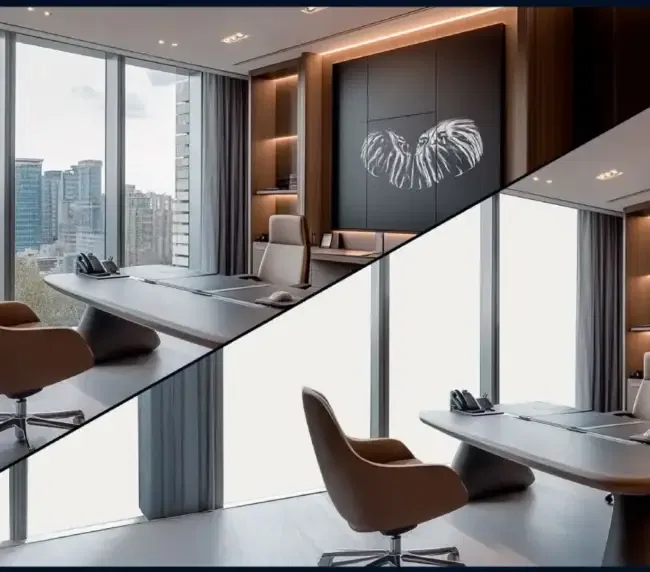
The transition between opaque and clear states happens instantly, providing on-demand privacy for executive offices and conference rooms.
What are the electrical requirements for PDLC smart film?
PDLC is an active electronic system — it requires a dedicated power source to function. It is not a passive film like standard window tint. (The running-cost math is in our guide to PDLC smart film power consumption.)
Most PDLC systems operate on low-voltage Alternating Current (AC), typically ranging from 48V to 65V. Using Direct Current (DC) will damage the liquid crystals and cause the film to fail prematurely. The system requires a transformer to step down standard building voltage to the required operating level. In a typical install we hide these transformers in the ceiling or a nearby equipment closet. Electricity is delivered to the film via busbars — thin copper conductive strips attached to the edges of the film.
From an efficiency standpoint, PDLC is remarkably low-power. On average, the film consumes approximately 5 watts per square meter when in the ON (clear) state. When the glass is OFF (opaque), it consumes zero power. For a standard office or bathroom window, electricity cost is negligible — often less than running a single LED light bulb.
How does PDLC film affect UV and infrared light?
Beyond privacy, one of the most significant technical advantages of PDLC is its performance as a protective barrier. The multi-layered construction acts as a powerful filter for harmful spectrums of light.
Smart film blocks 99% of Ultraviolet (UV) rays, regardless of whether the film is in the clear or opaque state. This is a critical metric for luxury residential projects where high-end furniture, flooring, and artwork need protection from sun damage and fading.
Be clear on what PDLC is not: it is a privacy and glare product, not a heat-rejection coating. The frosted state diffuses harsh direct sun and the film blocks UV, but if cutting solar heat gain is the goal, that is a glazing decision. Our honest guide to whether smart glass saves energy covers the difference.
What is the difference between smart glass and smart film?
A common question: smart glass vs. smart film. Both use PDLC technology, but the application method differs significantly.
Smart Glass is a factory-laminated product where the PDLC layer is sandwiched between two panes of tempered glass. This is the gold standard for new construction or full-window replacements. It offers the highest durability because the edges of the film are hermetically sealed within the glass unit.
Smart Film is a retrofit solution designed to be applied directly to the surface of existing glass. It features a self-adhesive layer on one side. This is often the preferred choice for commercial retrofits and residential upgrades where removing existing glass would be costly or disruptive. It’s more cost-effective and involves significantly less downtime.
Both options provide the same switching performance, but the installation environment — high-moisture bathrooms, for instance — may dictate which version is more appropriate.
What factors influence optical clarity?
No switchable glass is 100% clear. There is always a measurable level of haze. In the PDLC industry, haze refers to the percentage of light scattered when the film is in the transparent state. High-quality PDLC film typically has a haze rating between 3% and 5%. For a closer look at what that haze looks like in a real room, see how clear PDLC smart film is.
Viewing angle also affects clarity. PDLC film is clearest when viewed directly (at a 90-degree angle). As the viewing angle becomes more acute, you may notice a slight increase in haziness. This is a characteristic of the liquid crystal structure. When we perform a professional installation, we calibrate the film to the specific lighting conditions of the room to minimize the perception of haze.
How is PDLC smart film installed and maintained?
Installation is a high-precision process that requires a cleanroom-style environment. Even a single speck of dust trapped under the film can create a visible bubble. Our technicians perform a multi-stage cleaning process using specialized solutions to ensure the glass is surgically clean before the film is applied.
The wiring must be handled carefully. Busbars are fragile, and the lead wires must be routed through the window frame or behind decorative trim to remain invisible. We use non-acidic, specialized silicone to seal the edges — standard acetic silicones can corrode the PDLC material over time.
Maintenance is straightforward but specific:
- Clean smart film with a soft microfiber cloth and a mild, non-abrasive glass cleaner.
- Avoid soaking the edges of the film with liquid — moisture can wick into the layers and cause delamination over time.
- Do not use ammonia-based or abrasive cleaners. They can degrade the PET outer layer.
To see how these specs translate to a finished install, view our Beverly Hills executive conference room project — a PDLC smart film retrofit with wall-switch privacy control.
What should you decide before ordering the film?
Beyond the raw specs, a handful of decisions made at the consult stage determine whether the install holds up over its full lifespan. These are the ones we lock in on every project before glass or film is ordered:
- Product grade. Three tiers exist: cheap online kits (12–24 month lifespan), mid-grade PDLC (4–6 years), and warranted professional film (10+ years). The cost gap across tiers is roughly 1.5–2×, but the lifespan gap is 5–10× — most quality residential and commercial projects justify the professional tier on lifecycle math alone.
- Optical mode. Standard switchable film toggles between clear and frosted white. Tinted-mode variants toggle between clear and dark grey or black — useful for solar-gain reduction and theater-style rooms. Decide which behavior fits the room before the product order.
- Control path. Pick your control surface — wall switch, smartphone app, or smart-home integration — during the consult, before the electrician’s first visit. Smart-home integration is dramatically cheaper to plan up front than to retrofit with a second cable run later.
- Transformer capacity. The low-voltage transformer must be sized to total film square footage with margin. Undersized units cause control flicker and slow switch-over within months; sizing one capacity tier above the rated load avoids it.
- Glass condition. Retrofit film bonds best to clean, untreated glass. Existing tint, sun-control film, or frosted vinyl reduces optical clarity and may void the install warranty — plan removal as a prep step if the glass is treated.
- Warranty terms. Two warranties matter: the manufacturer’s (covering the film material) and the installer’s (covering workmanship). Quality professional film carries a 10+ year manufacturer warranty; a quality install warranty runs 5+ years on labor. Confirm both in writing before signing.
FAQ
Does PDLC smart film require battery power?
No. PDLC technology requires a constant electrical current to remain transparent. It must be hardwired into your building’s electrical system through a transformer. It cannot be operated effectively by batteries due to the voltage requirements.
What are the primary cost drivers for a PDLC project?
Pricing varies based on total square footage, wiring complexity (drilling through metal frames adds time), and the type of control system you choose (remote, wall switch, mobile app, or smart-home integration). The smart film cost breakdown shows how each of these drivers appears as a line item.
Can PDLC film be used in a shower?
Yes, but it requires specific installation techniques. We typically recommend using laminated smart glass for wet environments, or ensuring the edges of the retrofit film are expertly sealed with non-conductive silicone to prevent moisture ingress.
How long does PDLC film last?
When installed correctly and operated within its specified voltage, PDLC film has a life expectancy of over 80,000 hours in the ON state. That’s more than 10 years of continuous use — though most users only switch the film on when a room is occupied, extending effective lifespan considerably.
Can I control PDLC smart film with my phone?
Yes. Our systems can be integrated with most major smart home and building automation platforms — Lutron, Savant, and Alexa among them — which lets you set schedules or trigger privacy with a voice command.
Plan your PDLC install with Smart View
If you’ve read through what to know before buying PDLC smart film above and want a quote on your project — commercial build-out, luxury residence, executive office, medical suite, or retail storefront — our team handles everything from technical specs and wiring diagrams to the final precision application of the film. Request your estimate.