
Home vs Office Smart Glass: 7 Top Spec Differences (2026)

Switchable smart glass solves the same underlying problem in residential and commercial projects — privacy on demand, no compromise on daylight — but the spec details that matter most are different on each side. The control system that suits a Beverly Hills home office would be over-engineered for a 30-room creative-office floor; the laminated assembly that suits a Class A boardroom would be overkill for a master-bath retrofit.
This guide walks the seven home vs office smart glass spec differences that we explain on every consult call. Each comes from real LA-area installs we’ve shipped in the last 12 months, on both residential and commercial projects.
Why the Residential vs Commercial Split Matters Up Front
Most spec mistakes we fix don’t come from picking the wrong product family — they come from copy-pasting a residential spec onto an office floor (or vice versa) without rethinking the seven differences below. The product is the same PDLC-based switchable glass; the install, control, and budget patterns differ meaningfully by use case.
Match the spec to the actual environment up front and most downstream issues never surface. The seven items below are the ones we always raise.
The 7 Spec Differences
- 1. Glass count and total square footage. Home installs typically run 50–150 sq ft total — a couple of bathrooms, a French-door set, a bedroom window, front-door sidelights. Office installs scale 5–10× higher per project (full conference-room ring, 30+ partitions on a creative floor). The economics of cabling, drivers, and labor shift accordingly.
- 2. Control surface complexity. Homes default to a wall switch, sometimes paired with a smart-home tie-in (Lutron Caseta, voice assistant). Offices default to a BMS-integrated control system (Crestron, full Lutron RA3, Savant) so closing managers can flip privacy on as part of building lock-up. Pick the right path before the electrician shows up.
- 3. Default-state expectations. Homes appreciate “power off equals frosted” because a power outage defaults to privacy — homeowners feel safer. Offices want the same default but also need explicit briefing in tenant welcome packets so the first power flicker doesn’t trigger a facilities ticket.
- 4. Acoustic privacy pairing. Bathrooms and bedrooms rarely need acoustic privacy with their visual privacy — visual frost is enough. Conference rooms, executive offices, and HR rooms NEED both, which means specifying laminated or double-pane glass with the smart film applied to one face. Adds material cost on the office side that residential installs don’t carry.
- 5. Lifecycle and tenant turnover math. A homeowner installs once for the life of the home — 10+ years on warranted product, so the ownership horizon dictates payback. An office building absorbs 3–5 tenant turnovers per decade — switchable film survives all of them, blinds and frosted vinyl don’t. The financial case for switchable film is stronger on commercial assets because the alternative replacement cost is recurring.
- 6. HVAC coordination depth. Residential projects rarely need an HVAC review for a couple of bathroom windows. Commercial projects with 30+ glass partitions absolutely do — switchable film changes thermal load behavior in known ways, and the mechanical team needs glazing performance data during spec — manufacturer spec sheets cover film, and certified U-Factor/SHGC ratings are published for Smart View’s NFRC-rated smart glass picture windows.
- 7. Aesthetic finish standard. Homes tolerate visible bus-bar edges if they’re behind window trim. Offices in Class A space need flush trim, reveal details, and concealed wiring runs — the install reads as architectural, not retrofitted. Spec the finish detail during glass spec, not at install day.
How LA-Local Factors Shift the Math
Generic home-vs-office privacy spec works the same in any market. In LA the split gets sharper on three local factors: LA’s hybrid-work patterns blur the home/office line — many residential installs now include a home-office component that pulls in commercial-side specs like scene control and video-call privacy; LA’s commercial leasing market increasingly competes on amenity packages that include switchable spec; and LA’s climate, with peak summer cooling load on west-facing glazing, affects the energy-savings calculation differently for homes vs commercial — it’s a big part of why the HVAC review in difference #6 matters more here than in coastal-Pacific climates.
In real project math: a typical LA residential whole-home install (~150 sq ft across bathrooms, French doors, and front-door sidelights) is quoted in writing after a measurement, including the Caseta integration. A typical LA mid-size commercial floor (~500 sq ft across 30+ partitions) is quoted in writing including full BMS integration. The per-square-foot cost is comparable across both — the project economics differ in scale and in what each side values from the install.
How the Differences Compound
On a single residential bathroom, none of the seven differences much matters — pick the spec that fits the room and you’re done. On a multi-room residence with conference room, home office, and bath all on the same control system, you start blending residential and commercial patterns and the cost of getting it wrong climbs.
LA mixed-use buildings push this furthest — residential units and commercial amenity spaces increasingly sit under one BMS, so the spec has to bridge both sides. A unified BMS supports both with per-zone control logic: the same product family, two different control philosophies under one architecture, quoted in writing building-wide.
For the underlying product science behind both home and office variants, see our smart glass PDLC page — covers the spec details that drive the residential vs commercial choice on every install.
Where the Two Specs Diverge Most
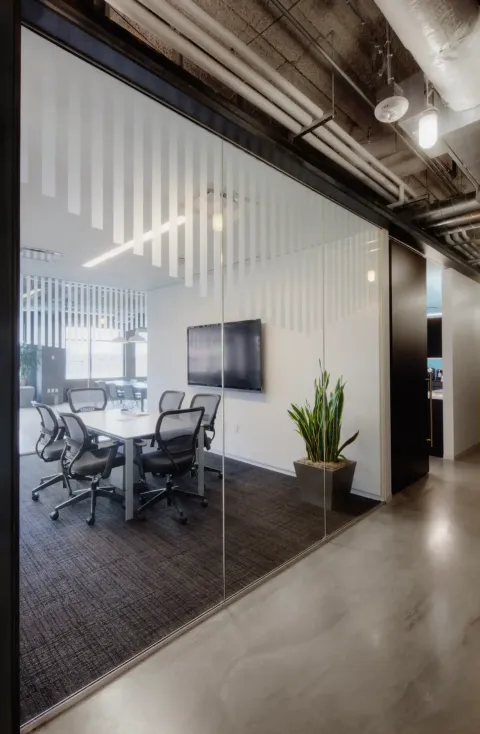
Across the LA-area projects we ship, the divergence between the two settings is sharpest on three specific dimensions: the BMS integration depth (offices yes, homes no), the acoustic-glass pairing (offices mandatory for confidential rooms, homes optional), and the financial-payback model (offices via tenant-turnover savings and amenity-package value, homes via lifestyle and resale value). The other four differences are scaling considerations on the same underlying product.
A Beverly Hills Front-Door Reference
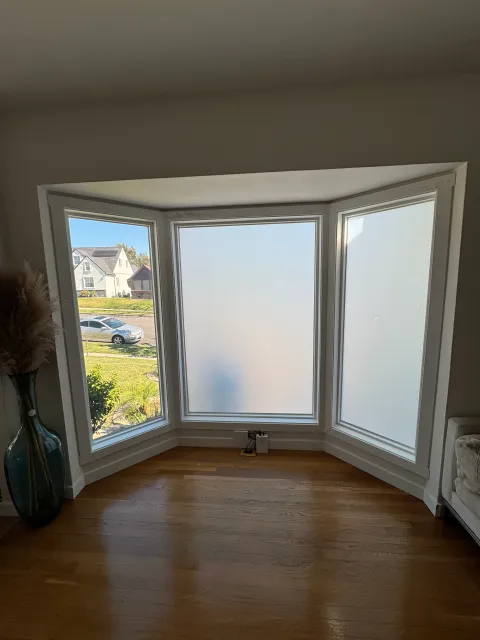
For a concrete example of these spec differences applied to a residential project, our Beverly Hills front-door install hits five of the seven directly. Original spec assumed an office-grade BMS tie-in; we right-sized to a Lutron Caseta integration during the design walk and saved the homeowner ~30% on control system cost without losing functionality.
Full project breakdown: smart glass front door in Beverly Hills — same spec playbook, single residential scope.
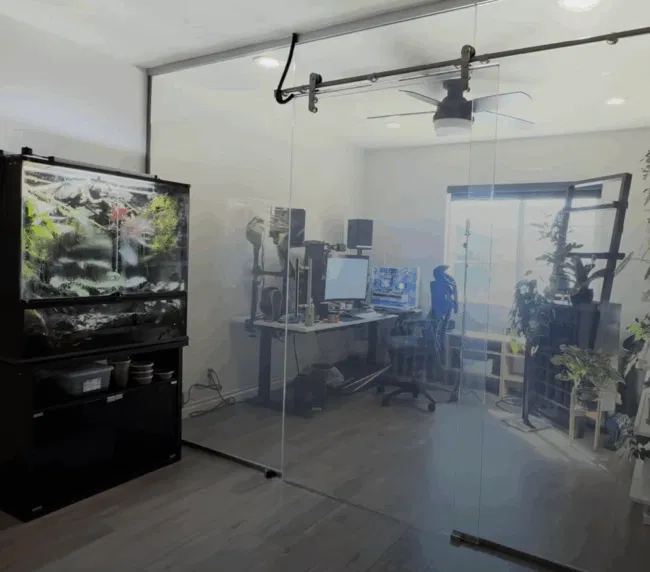
For the hybrid-work side of the divide — a residential partition-glass install with Lutron Caseta integration, smartphone-app fallback, and default-state-frosted on power loss — see our smart glass study room in Buena Park, a single-day retrofit on a single residential scope.
Planning Your Home or Office Install?
If price is what you are weighing, start on our smart glass cost page for the published per-square-foot numbers, then send us your details and we will turn that into a firm quote for your actual glass.