
The Glass-Walled Executive Office: Privacy at One Switch

A glass-walled executive office works because everyone can see in — and fails for exactly the same reason the moment the work turns confidential. Switchable PDLC glass resolves that trade-off: the glass front stays clear through open-door hours and frosts fully opaque at one press from the desk, with no curtains, no blinds, and no construction.
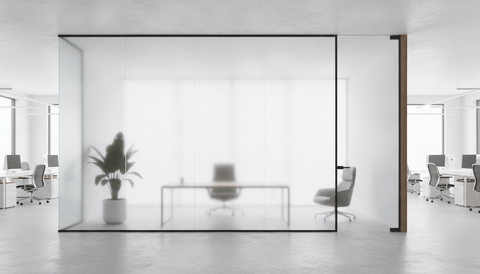
The corner-office trade-off nobody designs for
Modern offices put leadership behind glass on purpose. The see-through front signals availability, keeps the executive visually connected to the floor, and lets daylight run deep into the building. The plan works right up until the content of the work stops being public: compensation reviews, offers and terminations, legal calls, board prep, an acquisition nobody is supposed to know about yet.
In most buildings the answer to those moments is improvised — relocate to a windowless room, angle the monitor, or pull blinds that sag, gather dust, and announce "something sensitive is happening in here" to the entire floor. The office that was supposed to project openness ends up with its most important occupant regularly working somewhere else.
How the glass front switches sides
A switchable layer gives the same pane two states. Powered, the liquid-crystal film aligns and the glass reads as ordinary clear glazing; unpowered, it rests in a flat, even white frost that removes the sightline in both directions while daylight keeps passing through. The room goes private without going dark — and without the theater of closing blinds.
The change takes milliseconds and the whole panel switches at once, from a wall switch by the desk, a handheld remote, or a phone app. Because unpowered means frosted, a tripped breaker leaves the office private rather than exposed.
Can you add it to the office you already have?
Almost always. Retrofit smart film bonds to the interior face of the existing glass front, so the framing and the panes stay exactly as built. Each panel is patterned to its pane — the wide wall panels, the door glass, sidelights, and transoms are all cut individually — and the low-voltage wiring is run discreetly by our licensed crew (CA lic. #1134029) to wherever the control should live, usually within reach of the desk.
It is the same retrofit we spec across full floors of smart glass for offices, scaled down to a single room, and the install is planned around the executive's calendar — an office front is typically a same-day job.
Frost the wall, keep the sidelight
Panels can be zoned on separate circuits, and that is where a glass-fronted office gets clever. Frost the wide meeting-facing panel during a sensitive conversation and leave the narrow door light clear, and the room reads occupied-but-private instead of sealed. Group the whole front on one control, and one press takes the office fully dark to the floor — visually, not literally, since the frost keeps the light.
That flexibility is what we built for a Newport Beach CEO whose floor-to-ceiling glass wall overlooks the company's open workspace: roughly 50 square feet of switchable film retrofitted onto the existing wall, transitioning from fully transparent to fully opaque in under a second, with no frame removal and no downtime. He kept the connection to his team and gained a boardroom-grade private room, in the same footprint, on the same glass.
What executives ask before adding the switch
Can people see silhouettes through the frosted front?
Not at any normal distance. The frost is a flat translucent white — no outlines, colors, or movement read through it, so a conversation, a whiteboard, or a screen behind the frosted panel stays genuinely private, day or night.
Does the switchable layer block sound as well?
No. It removes the view, not the audio. Acoustic privacy comes from the wall assembly, the door, and its seals — the glass handles what people can see, and most glass-fronted offices treat the two together.
Can one control run the wall and the door glass separately?
Yes. Each pane can sit on its own circuit with its own switch, or the whole front can be grouped onto a single remote or app control. Zoning is decided during the walkthrough, because it drives the transformer count and the wiring plan.
What does a switchable office front cost?
A single small pane usually starts around $1,500 fully installed and scales with glass area, panel count, and controls, so a full office front is quoted per project. Send photos and rough dimensions and you'll have real numbers within one to two business days.
If there's a glass-fronted office in your building that empties out every time the conversation matters, it doesn't need curtains — it needs a switch. Request a free estimate or call Smart View Film Solutions at (866) 728-9888, and you'll have real numbers within one to two business days.