
Conference Room Privacy Film: 7 Expert Specs (2026)

Conference room glass has a specific job: stay open most of the day, go private the moment a confidential call starts, then revert without anyone touching a blind. Traditional privacy treatments (blinds, drapes, permanent frost) all fail at the “switch on demand” part. Switchable film is the category that solves it cleanly.
Conference room privacy film — the switchable PDLC layer applied directly to the existing glass — flips clear-to-frosted in about a second. This guide walks through the 7 specs that actually matter when you’re picking and pricing it for an office, boardroom, or executive suite in 2026.
Why Switchable Film Beats Blinds and Permanent Frost
Three failure modes show up on every office privacy review we run: blinds break and look residential in a Class A space, permanent frosted glass locks the room into a single mode, and after-market vinyl peels under HVAC airflow within a year. Switchable film avoids all three by doing the privacy work inside the glass itself, with no mechanical parts to wear out and no permanent visual commitment.
The catch: the spec needs to be right. The 7 specs below are what separate a polished install from a workable-but-disappointing one.
The 7 Specs That Separate a Polished Install From a Disappointing One
- 1. Switching speed. Quality PDLC film transitions in under 100 milliseconds — practically instantaneous. Anything slower than ~250ms feels laggy in a meeting context. Always confirm the manufacturer’s spec sheet number and watch a demo before signing.
- 2. Default state behavior. Switchable PDLC film is “normally opaque” — power off equals frosted. Critical for confidential rooms because a power failure defaults the glass to private, not to exposed. Always verify default-state behavior matches what the client expects — and put a short “your switchable glass behavior” note in the tenant welcome materials. The first time a building loses power, un-briefed tenants call facilities convinced the system is broken; most actually appreciate the default-to-private behavior once it’s explained.
- 3. Voltage and driver placement. Most quality PDLC operates on AC voltage via a low-voltage driver that has to live somewhere accessible (ceiling cavity, cabinet, IT closet). Identify the location during site measure — not on install day.
- 4. Glass compatibility (single-pane vs IGU vs laminated). Film bonds to the interior face of existing glass in nearly all cases. The exception: tempered IGUs need confirmation that the inner pane is accessible. Laminated assemblies open up acoustic privacy options on top of visual — and that matters more than most specs admit: a room that goes frosted but transmits voices through single-pane glass isn’t actually private. Lamination adds significant STC (acoustic) performance while the film handles the visual side, so solve both during the original glazing spec.
- 5. Control system integration. Wall switch is the default. Add-ons: handheld remote, smartphone app, or full BMS tie-in (Crestron, Lutron, Savant). Pick the path during the spec phase so the electrical run gets pulled correctly the first time.
- 6. Edge trim and bus-bar finish. The thin bus-bar at the edge of the film is visible up close — for a polished commercial install, spec a trim profile or a reveal detail so the finished glass reads as architectural rather than retrofitted.
- 7. UV stability and lifespan. Quality film is rated for 10+ years of continuous duty under indoor lighting and direct sun. Cheap film yellows, delaminates, or develops dead zones inside 18–24 months. Verify the warranty terms and the test-method standard before committing.
Where the Spec Earns Its Cost
Switchable film makes the strongest economic case in three scenarios: (1) tenant turnover is high and privacy preferences vary, (2) the room hosts confidential calls daily and acoustic + visual privacy both matter, (3) the architect specified glass walls and the developer needs a fix without losing the open-floor look.
Outside those three patterns, traditional treatments may pencil cheaper. Inside them, switchable film typically pays back inside the first lease cycle on tenant-replacement cost alone.
How It Stacks Up Against the Usual Alternatives
The case for switchable film gets clearest when you put it next to the alternatives most office spec’ers default to. Each row below reflects a real conversation we’ve had with a developer, GC, or office manager during a spec review.
- vs Blinds. Blinds give privacy on demand but require manual operation, look residential in a Class A space, collect dust on the slats, and break with frequency. Switchable film gives the same on-demand effect with no mechanical parts and no manual operation — one wall switch or BMS command per room.
- vs Permanent frosted glass. Frosted glass solves privacy but locks the room into a single mode forever. Switchable film gives you both modes with a single install — clear when the room is collaborative, frosted when the room is confidential — and re-spec’ing is just flipping a switch.
- vs Motorized roller shades. Motorized shades work, but they require structural mounting, intrude on the ceiling line, and add several seconds of transition time. PDLC film transitions in under a second with no visual intrusion above the glass.
- vs Cheap aftermarket vinyl film. Adhesive vinyl gives a permanent frosted look at low cost, but it can’t switch — and under HVAC airflow it peels and bubbles within 12–24 months. Switchable PDLC film with a real warranty lasts 10+ years and earns its cost over the building’s life. The spec-sheet price difference is usually under 2× the cheap-kit route; the quality and lifetime difference is 10×.
The pattern: switchable film wins on the dimensions that matter for a commercial conference room — speed, no mechanical parts, dual-mode flexibility, and lifespan. It loses on upfront cost vs the cheapest alternatives, which is the only legitimate reason an office manager might pick blinds or vinyl instead.
The Coordination Step the Spec Sheet Won’t Catch: HVAC
Frosted vinyl, blinds, and switchable film all change the thermal load profile of the glazing. If HVAC engineers aren’t looped in early, the system gets sized for either the wrong glass behavior or “tenant choice” — both expensive to correct mid-project. Switchable film ships with full manufacturer spec sheets, and for certified U-Factor and SHGC ratings, Smart View’s NFRC-rated smart glass picture windows give HVAC engineers lab-tested numbers to design around from day one. A 15-minute coordination call during glazing spec is all it takes.
The scale math is why it matters: on a single conference room, a missed spec is recoverable. On a 50,000 sq ft floor with 30+ glass partitions, the same mistake repeated 30 times becomes a multi-quarter facilities project — and most office managers only see the pattern after the second tenant-complaint cycle.
A Beverly Hills Boardroom Reference
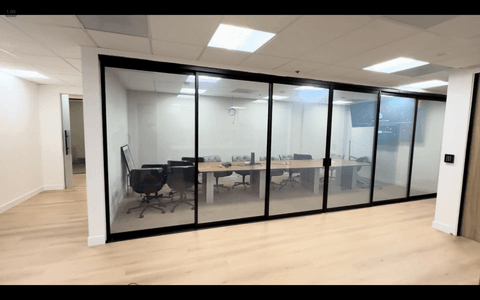
For a concrete example of the full spec list applied to a single project, our Beverly Hills boardroom install hits all 7 specs above. Original spec had blinds, single-pane glass, and no HVAC coordination; we redesigned to laminated assemblies + switchable film + Lutron tie-in during the design-walk phase, before glass order.
Full project breakdown: smart glass conference rooms in Beverly Hills — full spec, single client scope.
Spec Review for Your Office?
If price is what you are weighing, start on our smart glass cost page for the published per-square-foot numbers. Not ready for a full quote? Send the one thing you are unsure about — glass type, control wiring, timeline — through our contact page or call (866) 728-9888, and we will give you a straight answer.