Smart Glass for Open Offices: 7 Top Picks (2026)
Open-plan office layouts solve for collaboration but consistently fail on one thing: privacy on demand. Conference glass that’s transparent during a brainstorm needs to flip private the second a confidential review starts, with no curtains to draw and no acoustic panels to wheel in. Switchable smart glass for open offices is the spec that closes that gap without rebuilding walls.
This guide walks the seven smart glass for open offices spec picks we recommend on every open-plan consult. Each comes from real LA-area office installs we’ve shipped in the last 12 months across creative, tech, and professional-services tenants in Beverly Hills, Culver City, DTLA, and the Westside.
Why Smart Glass for Open Offices Solves the Open-Plan Privacy Gap
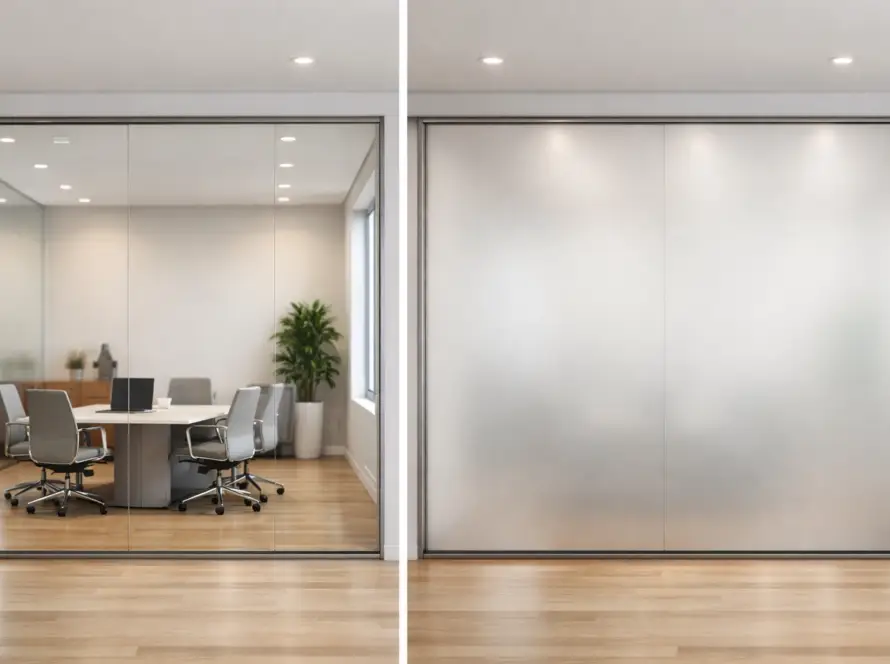
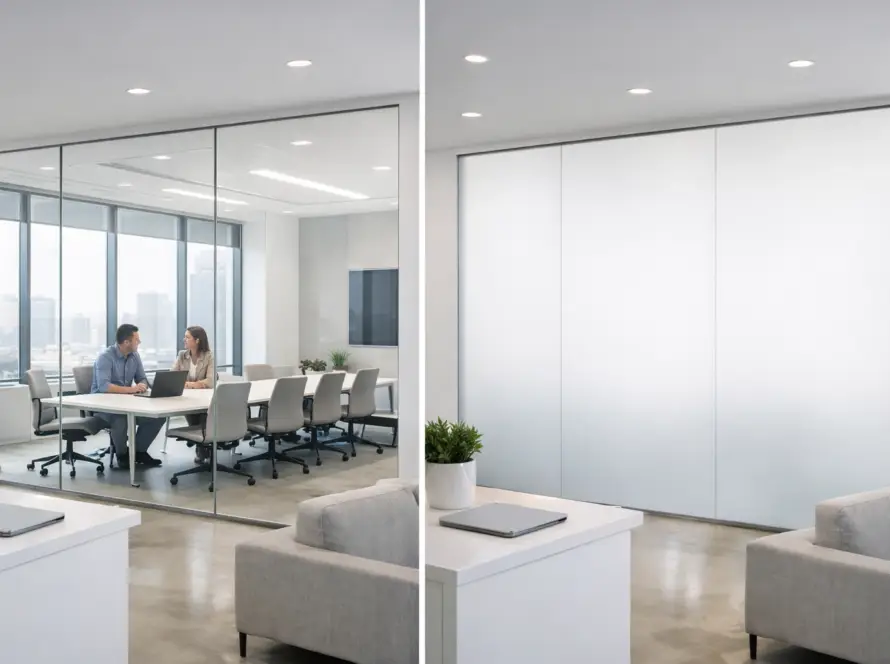
Open-plan floors trade enclosed offices for shared workspace and ringed conference rooms. The upside is daylight and team-cohesion; the downside is that every conference room becomes a glass box visible from every desk. Switchable smart glass for open offices flips the conference glass from transparent to frosted in about a second, restoring confidentiality on demand without compromising the open-plan ethos.
The seven picks below cover the spec patterns we see most often on open-office installs.
The 7 Smart Glass for Open Offices Spec Picks
- 1. Conference-room ring-frosting. The most common pick. Switchable smart glass on every conference-room wall in the open-floor ring. One-tap privacy from a wall switch or smartphone app; one-tap clear when the meeting wraps. Defaults to clear in normal mode so the rooms read as open and approachable.
- 2. Phone-booth and focus-room glass. Open-plan offices increasingly include 1–2 person phone booths and focus pods. Switchable glass on these units gives the user instant visual privacy for sensitive calls without the booth feeling claustrophobic when not in use.
- 3. Executive-suite glass walls in open-plan layouts. Even in flat-hierarchy creative offices, leadership often has a small enclosed area for confidential reviews. Smart glass for open offices on this wall lets the exec keep the glass clear and accessible by default but flip private during 1:1s or board-prep work.
- 4. HR and people-ops privacy spec. HR conversations require absolute confidentiality. Switchable glass on the HR room glass wall is the smallest-footprint privacy upgrade an open-plan office can ship — one room, two glass walls, immediate compliance with confidentiality expectations.
- 5. Client-meeting room with brand-display privacy mode. For client-facing creative offices, switchable glass with a custom-cut brand mark in the frosted state turns the client room into a brand display in privacy mode. Doubles as design statement and confidentiality measure.
- 6. Reconfigurable team-zone partitions. Some open-plan offices want movable team zones. Switchable glass on partition walls lets a team zone stay open during cross-team work and flip private during deep-focus sprints — without permanently rebuilding the partition layout.
- 7. Reception-area street-glass control. Open-plan offices on ground-floor commercial blocks often have street-facing reception glass. Switchable smart glass spec on this glass lets the office stay clear and inviting during business hours, then flip frosted after hours for security and reduced after-hours visibility.
Where Smart Glass for Open Offices Earns the Spec Cost Fastest
Across the open-plan installs we ship, the smart glass for open offices spec earns its cost back fastest in three office types:
- Mid-size creative and tech tenants on 5,000–25,000 sq ft floors. The conference-room ring is large enough that traditional treatments (curtains, acoustic panels, vinyl frosting) become a maintenance line item. Switchable glass eliminates that line item across a 5-year lease.
- Professional-services tenants with HR, legal, and confidential-review rooms. The compliance value of always-available confidentiality is meaningful enough to pencil out the spec cost on its own — the brand-display and reception value are upside.
- Multi-tenant open-plan buildings with shared conference rooms. A bookable conference-room ring shared across tenants benefits from a tenant-controllable privacy spec — switchable glass with per-room control gives each tenant the privacy they need without re-spec on turnover.
For technical context on the underlying switchable-glass technology that powers all 7 picks above, see our smart glass PDLC page — covers the spec details that determine product behavior across residential and commercial installs.
How Smart Glass for Open Offices Compounds Across a Multi-Room Office
The seven picks above don’t sit in isolation — on a typical mid-size open-plan office floor with 4 conference rooms, 2 phone booths, an executive suite, an HR room, and a client room, four to six of these picks compound on the same install. The cabling spec, driver placement, and BMS integration scale cleanly across room types because the underlying product is the same switchable glass — only the control surface differs by room.
For multi-room open-plan offices, this means a building-wide switchable-glass standard can serve very different room types under one control system. The cost per room drops as the install scales — a 4-room install costs more per room than a 10-room install on the same floor.
Smart Glass for Open Offices in Real Project Math
For a typical LA mid-size open-plan office (5,000–10,000 sq ft, 4 conference rooms ringed in glass), switchable smart glass for open offices on the conference ring runs roughly $25,000–45,000 installed. The recurring alternative cost — curtains, acoustic panels, vinyl frosting maintenance — runs $4,000–7,000 per year across a 4-room ring, so the switchable spec pays back in roughly 5–8 years on maintenance alone, not counting the daily-use confidentiality value.
For an open-plan office with conference ring plus 2 phone booths plus HR room plus client room (~10 glass surfaces total), spec runs $45,000–75,000 installed. Same product, scaled.
A Beverly Hills Conference-Room Reference
For a concrete example of these smart glass for open offices picks applied end-to-end on a single project, our Beverly Hills boardroom install hits five of the seven picks directly. Conference-room ring-frosting on 4 surfaces, executive-suite glass wall, brand-display client-meeting room, and HR-room privacy spec — all on a unified BMS-integrated control system.
Full project breakdown: smart glass conference rooms in Beverly Hills — same spec playbook applied to a single Class A office project.
Planning Your Open-Office Smart Glass Install?
If you’re spec’ing switchable glass for an open-plan office build-out or tenant improvement, a 30-minute spec review can identify which of the seven smart glass for open offices picks apply most to your scope before glass is ordered. No sales pressure — straight read on which picks fit your floor plan and tenant profile.
Contact Smart View with the office type, glass count, and conference-room ring size, and we’ll outline which picks are most relevant to your build-out.