
Switchable Glass for West-Facing LA Window Glare

Switchable glass fixes the glare a west-facing LA window throws every afternoon: at the touch of a switch the pane turns to an even, milky-white frost that scatters the low sun into soft, uniform light — no squinting, no washed-out screens — then clears back to a full view once the sun drops.
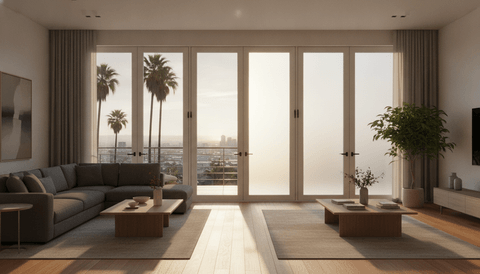
West-facing rooms are the ones that go unusable between about 3 and 6 p.m. The sun drops low, comes in almost level with the glass, and no amount of squinting fixes it. Instead of choosing between the view and the glare, switchable glass lets you switch between them. Here is what the glare actually costs you, how frosting the glass tames it, where the honest limits are, and what the fix costs.
Why a west-facing room turns unusable after lunch
Los Angeles gets sun nearly year-round, and the worst of it on a west wall isn't midday — it's the long, low light of late afternoon. That low angle is what makes the glare so punishing: it comes in under the eaves, level with your eyes and your screens, and it lasts for hours. A TV washes out. A laptop turns into a mirror. The couch, the rug, and the art take the full-strength beam day after day, and the room bakes into a hot-spot right when the family gets home.
The usual fixes all cost you something. Close the blinds and you trade the glare for a dark, boxed-in room — and you lose the view you paid for. Fixed tint or frosted vinyl dims the glass permanently, so the window is compromised at 9 a.m. for a problem that only shows up at 5. Motorized shades help, but they still block the view when they're down and add one more motor to maintain.
How does frosting the glass actually cut glare?
The glass carries a PDLC (polymer-dispersed liquid crystal) layer. Powered, the crystals line up and the pane reads crystal clear; cut the power and it returns to a flat, even, milky-white frost. That frost is the part that kills glare: instead of passing the sun through as a single harsh beam, the translucent layer scatters it in every direction, so what reaches the room is soft, diffuse, even light. The hard shadows and the mirror-glare on your screens disappear — but the daylight doesn't, so the room stays bright.
Because the change takes under a second, you match it to the sun: clear all morning while the west wall sits in shade, one switch to frost when the glare arrives, clear again once the sun drops below the horizon. Add a schedule or an app and the window handles it on its own — frosting in the late afternoon and clearing at dusk without anyone touching a switch.
Glare control on demand, not all-day darkness
This is where switchable glass separates from every other option: it only works when you ask it to. A blind, a tint, or a curtain is a standing compromise — it dims the room whether the sun is on the glass or not. Switchable glass is clear by default and private only on demand, so the window stays a full, open view for the twenty hours a day the glare isn't a problem and becomes a soft frosted panel for the few hours it is.
On windows you already own, the same effect comes from switchable smart film bonded to the interior face of the existing glass — single-pane or double-pane, with no need to replace the window. On a remodel or new build, the switchable layer comes laminated inside new glass instead.
The honest limit: glare is not the same as heat
Worth being straight about the boundary. Frosting the glass solves the visual problem — glare, hot-spots, washed-out screens, and the privacy a low sun's angle also exposes. It is not a solar-control or blackout product. The film carries UV inhibitors that protect furnishings and keep the liquid-crystal layer stable in full western exposure, and diffusing the beam does take the harsh edge off the room, but a switchable panel is not engineered to reject heat the way a low-E, spectrally-selective glass unit is. If your real goal is cutting the cooling load on a wall of afternoon glass, that's a glazing conversation — and the certified U-Factor and SHGC ratings that describe heat performance apply to our smart-glass picture windows, not to retrofit film. For glare, comfort, and privacy on the glass you already have, though, switching it is the cleanest fix there is.
What it looks like on real west-facing glass
The wall of glass that shows this off best is a set of French doors. They're often the westernmost glass in the house, they're where the late sun comes in hardest, and they're exactly where blinds look worst. We replaced the panels on a Los Angeles living-room French-door set with switchable glass — clear for the view onto the yard, frosted on one switch when the afternoon sun turns the room into a glare box. The full write-up is in our smart glass French doors project in Los Angeles; the same spec covers a west-facing picture window, a slider, or a bank of tall windows.
What it costs to tame a west-facing window
Pricing scales with glass area and the controls you choose. A single small window usually starts around $1,500 fully installed and climbs from there — one west-facing window sits near the low end, a wall of French doors or floor-to-ceiling glass scales with the square footage. The honest breakdown of what drives the number, film versus new glass, is on our smart glass cost page. Quoting is remote: send photos and rough dimensions of the window, and you'll have real numbers within one to two business days — no site visit needed to get a price.
Questions about glare and west-facing glass
Does frosting a west-facing window make the room dark?
No. The frost is a translucent white that diffuses the harsh afternoon beam into soft, even daylight, so the room stays bright — it removes the glare and the hot-spots, not the light.
Will switchable glass block the heat from the afternoon sun too?
It cuts the visual glare and its UV inhibitors protect your furnishings, but a retrofit switchable panel isn't a heat-rejection product. Meaningful solar-heat control is a job for a low-E glass unit, and the certified U-Factor and SHGC ratings that describe heat performance belong to our smart-glass picture windows, not to film.
Can I put switchable film on the west-facing windows I already have?
Almost always. Smart film bonds to the interior face of existing glass, single-pane or double-pane, with no need to replace the window. Heavily tinted or already-treated glass gets evaluated case by case before we quote.
The glare shows up at the same hour every afternoon — and a west-facing window that switches to frost the moment it does is the fix a blind can't match. Request your estimate or call (866) 728-9888 with photos and rough sizes of the window, and we'll send real numbers within one to two business days.