
How Smart Glass Turns From Clear to Frosted

Smart glass turns from clear to frosted because of a thin layer inside it called PDLC — polymer-dispersed liquid crystal. Send power through it and microscopic liquid crystals line up so light passes straight through, and the glass looks clear. Cut the power and those crystals scatter the light in every direction, and the pane goes to a flat, even frost.

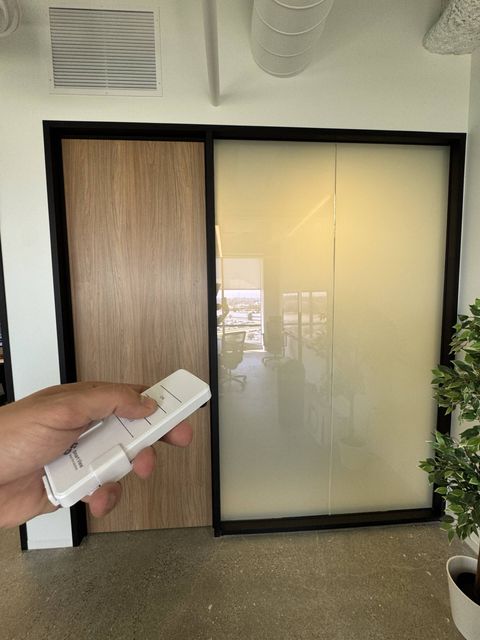
So how does smart glass turn from clear to frosted in real life — what triggers it, how quickly it happens, and whether that frost is really “fog”? Here is what is going on behind the switch, in plain terms.
The liquid-crystal layer behind the change
Inside every switchable panel sits a layer thinner than a sheet of paper: millions of tiny liquid-crystal droplets held in a clear plastic, sandwiched between two see-through conductive coatings that carry a low-voltage current. With no power, the crystals inside each droplet point every which way, so light hitting all those mismatched boundaries scatters — the pane looks milky and private, yet still glows with daylight. Feed current across the layer and the crystals swing into alignment, the droplets and the plastic bend light identically, and the view snaps back to clear. There are no shutters, louvers, or moving parts — only crystals ordering and scattering. If you want the full engineering walkthrough, we lay it out on how smart glass works.
What actually flips it clear or frosted?
The trigger is electrical, never mechanical. Every control does the same underlying job — it opens or cuts the current to the layer. A wall switch, mounted and wired like an ordinary light dimmer, is the most common. A handheld remote (the one in the photo above) toggles the same circuit without getting up. And a smartphone app or smart-home command — tied into systems like Lutron, Control4, or a voice assistant — can flip it on a schedule or by voice. Whichever you pick, the glass itself behaves identically: powered means clear, unpowered means frosted. That is true of both a factory-made smart glass panel and a switchable film retrofitted onto glass you already own.
Is that frost the same as a foggy bathroom mirror?
No — and this is the most common misread. A fogged mirror is water: warm, moist air condensing into droplets on a cold surface, which you can wipe away. Smart glass frost is bone dry. Nothing settles on the surface; the “frost” is light scattering inside the sealed film, so there is nothing to wipe off and nothing that lingers. It appears and vanishes the instant the power changes, not gradually the way a mirror clears. It also frosts to a bright, translucent white rather than going dark — which is what separates it from electrochromic tinting glass, a different product that dims a window to cut glare rather than turning it private.
Why frosted is the resting state
Frosted is what the glass does with no power at all, and clear is the state it has to be pushed into. That is deliberate. It means the glass only draws power while it is clear, and — more importantly — a tripped breaker, a pulled plug, or a full outage leaves the room private, not exposed. The fail-safe direction is the one you would want: when in doubt, the glass hides the room rather than revealing it. It is also why nobody has to remember to “turn on” privacy; letting go of the switch is the private state.
How fast is the switch, and does it wear out?
The change is effectively instant — under a second, usually under a quarter of one — because aligning crystals in an electric field happens almost immediately. And because nothing physically moves, there is no mechanism to fatigue: switching simply applies or removes voltage, so flipping the glass clear and frosted thousands of times does not wear the switch out the way a motor or a cord would. What ages film over the long run is sunlight and heat, not how often you toggle it. You can watch that instant clear-to-frost change on a full six-panel glass wall in our smart glass conference room in Thousand Oaks, where one switch takes an open meeting room private mid-conversation.
Questions about how smart glass switches
Does smart glass turn frosted or dark when it is off?
Frosted white, not dark. The liquid crystals scatter light into a translucent frost, so the room stays bright even when the glass is private. Going dark to cut sun is a different product (electrochromic tint); switchable privacy glass frosts instead.
Does smart glass fog up on its own?
No. The frosted look is not condensation and does not happen from humidity or temperature. It only changes when the power to the layer changes — the glass stays exactly clear or exactly frosted until something flips the switch.
How is the clear-to-frosted switch controlled?
By a wall switch, a handheld remote, or a phone app / smart-home command. All three do the same thing: open or cut the low-voltage current, which lines the crystals up (clear) or lets them scatter (frosted).
What happens to smart glass during a power outage?
It returns to frosted. Because frosted is the unpowered default, losing power defaults the room to private rather than exposed — the reason many owners find the fail-safe reassuring rather than a drawback.
That is the whole trick behind the switch: current orders the crystals clear, no current lets them scatter to frost, in about a second either way. Request your estimate or call (866) 728-9888 with photos and rough sizes of your glass, and we will send real numbers within one to two business days.