Modern Workspace Efficiency: Maximizing Property Value with Switchable Privacy Technology
In the competitive landscape of commercial real estate development, the difference between a high-vacancy building and a premium, fully-leased office asset often comes down to the quality of the interior environment. Modern tenants no longer view office space as just a place to sit; they view it as a tool for talent retention, productivity, and brand identity. Developers who prioritize flexible, tech-forward environments gain a significant edge. However, many developers still fall into common traps regarding one of the most critical aspects of office design: privacy.
Privacy in a glass-heavy modern office is a complex challenge. While floor-to-ceiling glass creates an impressive aesthetic and allows light to penetrate deep into the floor plate, it often leaves employees feeling exposed. Traditional solutions like mechanical blinds or frosted vinyl are increasingly viewed as outdated or insufficient. By understanding the mistakes made during the development and fit-out phases, property owners can implement professional smart film installation to solve these issues permanently.
1. Relying on Traditional Blinds and Curtains
The most common mistake in commercial development is falling back on mechanical window treatments. While blinds are a known quantity, they present significant long-term drawbacks for property managers and developers. Blinds collect dust, allergens, and pathogens, requiring frequent professional cleaning to maintain a healthy work environment. Furthermore, mechanical parts, cords, slats, and motors, are prone to breaking under heavy use in a commercial setting.
Smart film eliminates these maintenance overheads. Because the PDLC (Polymer Dispersed Liquid Crystal) layer is applied directly to the glass or laminated within it, there are no moving parts to repair and no surfaces to trap dust. For a developer looking at a 10-year lifecycle cost, the reduction in cleaning and replacement expenses makes switchable technology a superior investment.
2. Installing Permanent Frosted Glass
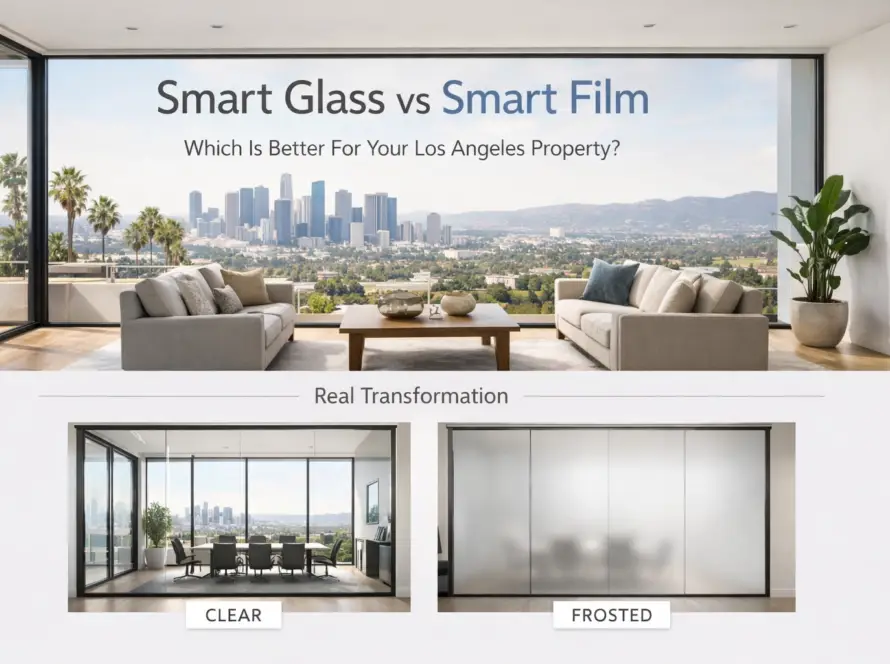
In an attempt to guarantee privacy for conference rooms or executive offices, developers often specify sandblasted or acid-etched glass. While this provides privacy, it is a "static" solution. Once the glass is frosted, it remains opaque forever. This permanently cuts off visual flow and can make a sophisticated office feel segmented and cramped.
Switchable smart film allows for dynamic space management. You can explore our recent smart film projects to see how rooms can transition from completely transparent to fully opaque in less than a millisecond. This flexibility allows tenants to keep the office feeling open and collaborative during the day while securing total visual privacy for sensitive board meetings at the touch of a button.
3. Sacrificing Natural Light for Discretion
There is a direct correlation between access to natural light and employee productivity. Studies consistently show that "light starvation" in the workplace leads to higher rates of absenteeism and lower morale. A common mistake is using dark tints or heavy partitions to create private zones, which inadvertently blocks the path of sunlight.
Smart film is engineered to solve this exact conflict. When in its opaque (off) state, the PDLC crystals scatter light, providing total visual privacy while still allowing approximately 60-70% of ambient light to pass through. This means interior offices remain bright and energized even when the privacy mode is activated.
4. Underestimating the Cost of Tenant Turnover
Commercial developers must design with the "next tenant" in mind. If a space is built with fixed walls or specific frosted patterns that suited a previous occupant, the cost of "white-boxing" the space for a new lease increases significantly. Demolishing walls and replacing glass partitions is expensive and creates immense waste.
By utilizing smart film, developers create a "future-proof" shell. The technology integrates into the building’s infrastructure, allowing any future tenant to customize their privacy settings via software or wall switches without needing a single construction crew to enter the building.
5. Overlooking Energy Efficiency and HVAC Loads
Large expanses of glass are notorious for "greenhouse effects," where solar heat gain forces HVAC systems to work overtime. Many developers ignore the thermal performance of their interior glass partitions, focusing only on the exterior envelope.
Smart film provides an added layer of thermal insulation. Our PDLC films block up to 99% of harmful UV rays and a significant portion of infrared heat. This protection prevents office furniture and flooring from fading and reduces the cooling load required for interior zones. When multiplied across several floors of a high-rise, the energy savings contribute directly to the building's LEED certification and overall valuation.
6. Neglecting Acoustic Privacy in Glass Designs
A frequent complaint in modern glass-walled offices is that while the space looks "private," every word spoken inside a meeting room carries into the hallway. While smart film primarily addresses visual privacy, custom smart glass systems and high-quality retrofit films also contribute to a reduction in sound transmission. The additional layers applied to the glass help dampen vibrations, providing a slight but measurable increase in the STC (Sound Transmission Class) rating of the partition.
7. Choosing Low-Quality DIY Products Over Professional Installation
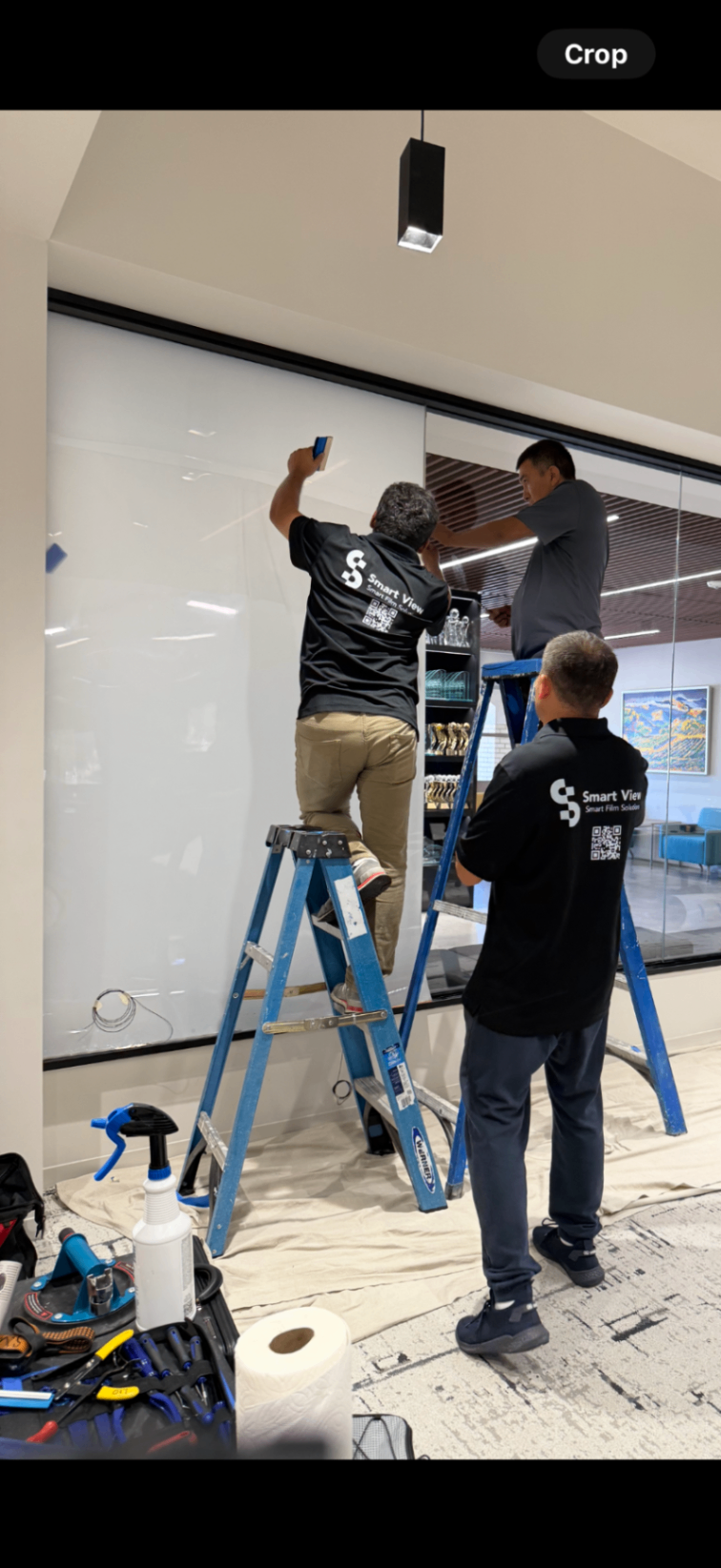
In an effort to trim budgets, some developers or contractors attempt to source "off-the-shelf" privacy films. This is a critical error. Commercial-grade PDLC film requires precise electrical engineering, specific transformer configurations, and expert edge-sealing to prevent delamination.
At Smart View Smart Film Solutions, we ensure that every installation is edge-to-edge, with hidden wiring and professional-grade busbars. This ensures the film remains durable for years of constant switching. Poorly installed film often shows "halos" or bubbles within months, leading to costly warranty claims and tenant dissatisfaction.
Technical Specifications for Developers
For the engineering-minded developer, the performance metrics of smart film are impressive. The film typically operates on 48V to 60V AC power, provided by a dedicated transformer. The power consumption is incredibly low, usually less than 0.5 Watts per square foot when in the clear (on) state. When the power is cut, the liquid crystals return to a random, scattered orientation, creating the opaque "frosted" effect instantly. This "fail-safe" to opaque ensures that if power is lost, privacy is maintained.
Durability is another key factor. Our films are tested for over 3 million switches, meaning that even in a high-traffic office where the film is toggled dozens of times a day, the system will last for well over a decade. This reliability is why smart film is becoming the standard for Class-A office space in major metropolitan hubs.
How Smart Film Enhances Property Valuation
For a developer, every square foot must justify its cost. Incorporating smart technology into a building’s base-build or as a premium tenant improvement (TI) allowance increases the "perceived value" of the square footage. It signals to potential high-value tenants, such as law firms, tech companies, and medical suites, that the building is managed with a focus on modern efficiency and worker wellness.
The ability to market a "smart building" allows for higher rental rates and longer lease terms. Tenants are willing to pay a premium for spaces that are move-in ready and equipped with integrated privacy controls that work with their existing smart-office apps and voice commands.
FAQ: Common Questions from Commercial Developers
What is the typical lead time for a large-scale smart film installation?
Project timelines depend heavily on the total square footage and the complexity of the glass partitions. Generally, once measurements are finalized and the film is custom-cut, installation for a standard office floor can be completed in a matter of days. We recommend involving our team during the electrical rough-in phase to ensure that power sources and conduits are correctly placed for a seamless, "invisible" wiring finish.
Can smart film be integrated into our existing Building Management System (BMS)?
Yes. Smart film is highly compatible with modern automation. We can configure the system to be controlled via wall switches, remote controls, smartphone apps, or integrated directly into a BMS (such as Crestron, Lutron, or Savant). This allows property managers to set "global" rules, such as turning all film to opaque after business hours to enhance building security.
Does the film require special cleaning agents?
No specialized chemicals are required, which is a major benefit for commercial cleaning crews. We recommend a simple solution of isopropyl alcohol and a soft microfiber cloth. This ease of maintenance is a significant upgrade over traditional window treatments that require vacuuming or steam cleaning.
Is smart film or smart glass better for a new development?
This depends on whether you are retrofitting an existing space or building from the ground up. Smart glass (where the PDLC is laminated between two panes) is ideal for new construction as it offers the cleanest look and maximum durability. Smart film is the perfect retrofit solution for existing glass partitions, providing the same functionality without the need to remove the current glass. You can learn more about these differences in our previous blog post on commercial office trends.
How does the film handle high-traffic areas like entrance doors?
Our installation process includes specialized "power transfer" hardware for operable doors. This ensures that the electrical connection remains stable even as doors are opened and closed thousands of times. The film is scratch-resistant and designed to withstand the rigors of a busy corporate environment.
Secure Your Property Value Today
Investing in smart film is more than an aesthetic choice; it is a strategic business decision. By avoiding the mistakes of static privacy and high-maintenance blinds, you create a dynamic, efficient, and highly marketable environment. Smart View Smart Film Solutions provides end-to-end expertise, from technical consultation to final installation, ensuring your office project meets the highest standards of modern design.
To see how switchable technology can be integrated into your next development or to request a custom quote for your specific square footage and control requirements, contact our team of expert installers today. We provide site evaluations and detailed proposals to help you maximize the ROI of your glass assets.