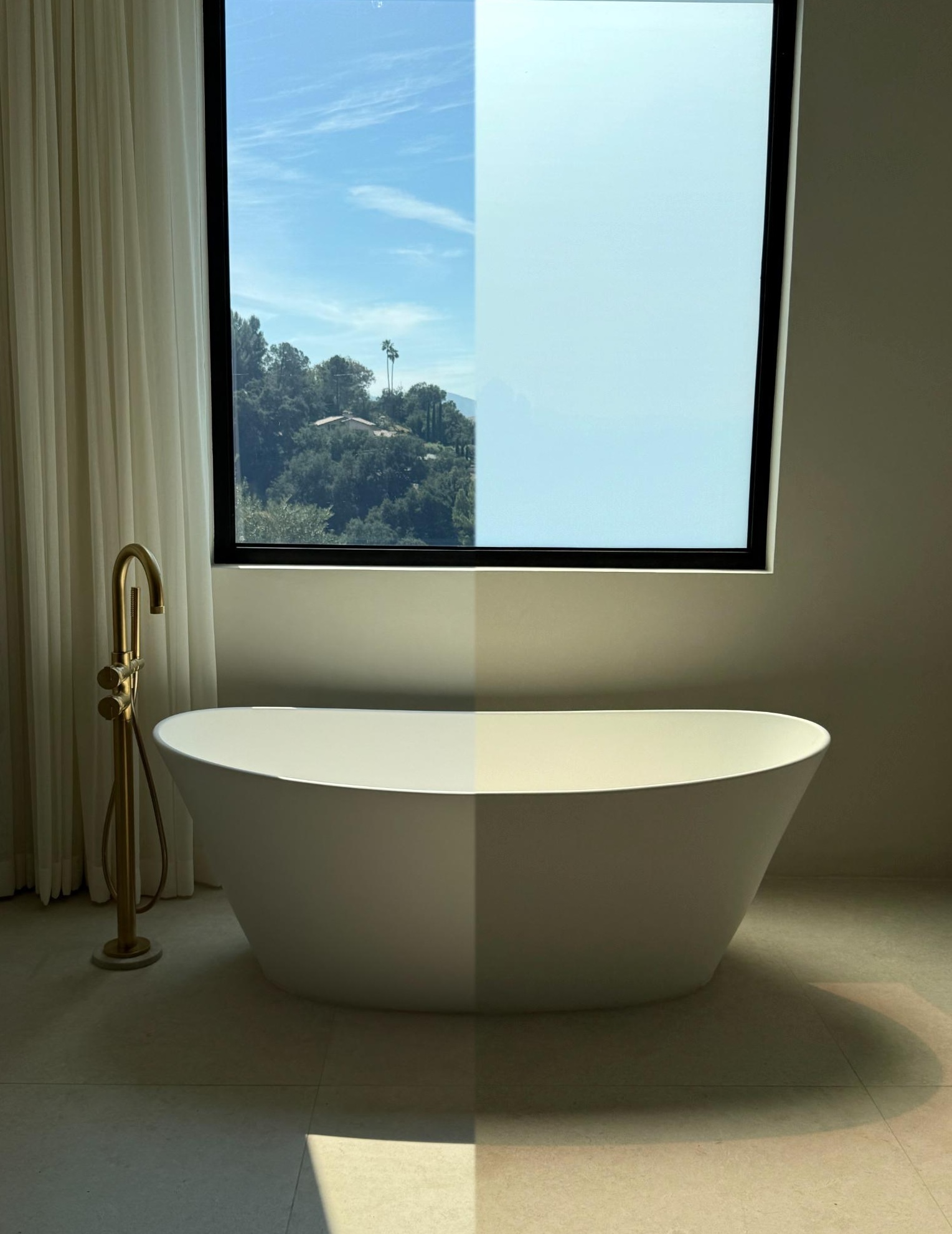
Switchable Smart Glass Benefits: 7 Top Wins (2026)
Switchable smart glass is increasingly part of the expected stack on LA luxury and modern residential — alongside Lutron, Savant, integrated audio, and smart climate. The seven switchable smart glass benefits below are why the spec keeps showing up on more LA-area homes year over year, drawn from real installs we’ve shipped across Beverly Hills, Bel Air, Holmby Hills, Pacific Palisades, and the Westside in the last 12 months.
This guide walks the seven switchable smart glass benefits we surface on every residential consult that needs the value-prop framing. Each comes from real LA-area installs and the resale-and-lifecycle math behind why each benefit pencils out for the homes where it fits.
Why Switchable Smart Glass Benefits Stack on Modern LA Homes
Generic privacy treatments — blinds, curtains, drapes, frosted vinyl — solve one problem (privacy on demand) at the cost of three others (daylight, aesthetic, lifecycle). Switchable smart glass benefits resolve all four: privacy without daylight loss, privacy without architectural compromise, privacy without recurring replacement cost, and privacy that integrates natively with the connected-home stack LA buyers already expect. The seven wins below are how those benefits show up in practice.
The 7 Top Switchable Smart Glass Benefits
- 1. Privacy switch speed under one second. Switchable smart glass flips from clear to frosted in under a second — wall switch, smartphone, or voice command. Traditional treatments require physically reaching the window, operating the cord or wand, adjusting slat angle. The speed delta matters most on bathroom and bedroom glass where privacy is needed in a hurry.
- 2. Daylight retention in privacy mode. Closed blinds block 80–95% of incoming daylight. Switchable smart glass benefits include keeping roughly 60–70% of incoming daylight as soft diffused light in frosted mode — privacy without throwing the room into artificial-lighting reliance. Particularly valuable in single-window or north-facing rooms where daylight is at a premium.
- 3. 10-year lifespan vs 3–6-year treatment cycles. Quality switchable smart glass carries 10+ year warranted lifespan with no recurring maintenance. Blinds typically need replacement every 3–6 years; curtains every 8–12; vinyl peels at edges within 1–3. Across a 10-year ownership window, the homeowner buys treatments 2–3 times and switchable glass once.
- 4. Smart-home native integration. Switchable smart glass benefits integrate cleanly with Lutron, Savant, Crestron, Alexa, Google Home, and Apple HomeKit — wall switches, smartphone apps, voice assistants, scheduled scenes. Motorized treatments with comparable smart-home integration cost roughly the same as switchable glass and don’t deliver the privacy-on-demand value or architectural-fit benefit.
- 5. Resale value contribution on luxury LA market. Switchable smart glass reads as a premium-finish upgrade to LA-area buyers — same category as smart thermostats, integrated audio, and concealed wiring. Comparable homes without the spec read as dated. Resale premium typically runs $15,000–40,000 on a $2M–5M property, well above install cost on a multi-room residence.
- 6. Architectural minimalism on modern and mid-century homes. Modern, mid-century, and luxury-contemporary LA homes increasingly use floor-to-ceiling glass and frameless window architecture. Treatments clutter that aesthetic with hardware and fabric; switchable smart glass disappears into the architecture as flush integrated privacy. For homeowners who chose the home for its architectural lines, this benefit is often decisive.
- 7. No dust accumulation, no allergen surface. Treatments are dust collectors — horizontal blind slats, fabric drape pleats, mini-blind mechanisms all trap dust and allergens. Switchable smart glass is a flat smooth surface — wipes clean in seconds, traps no allergens, disappears from the cleaning rotation entirely. Lifestyle win for allergen-sensitive households across multiple bathrooms and bedrooms.
For technical context on the underlying technology that powers all 7 switchable smart glass benefits, see our smart glass PDLC page — covers the spec details that determine product behavior across residential applications.
Where the Switchable Smart Glass Benefits Stack Strongest
Across the LA-area residential installs we ship, the seven switchable smart glass benefits compound most decisively on three home types:
- Modern and mid-century homes with frameless or floor-to-ceiling glazing. Architectural fit (#6) plus speed (#1) plus resale (#5) compound — the spec reads as native to the home rather than retrofit.
- Multi-bathroom luxury homes (3+ bath). Lifespan (#3) and dust/allergen elimination (#7) compound across multiple bathrooms — the recurring maintenance load on traditional treatments becomes meaningful at scale.
- Smart-home-equipped residences with Lutron, Savant, or Crestron BMS. Native integration (#4) is decisive — the hub is already paid for, and adding switchable glass as a scene element is incremental cost with high lifestyle return.
How the 7 Benefits Compound Across a Whole-Home Install
The seven wins above don’t sit in isolation — on a typical LA luxury whole-home install (4–8 glass surfaces across bathrooms, bedrooms, French doors, and front-door sidelights), four to six of these switchable smart glass benefits compound on the same project. Once smart-home integration is wired and cabling is laid out for one room, additional rooms add only the per-room product cost. Per-room cost on rooms 3–5 is significantly lower than on rooms 1–2 because the integration infrastructure is shared.
For multi-room luxury residential, this means a home-wide switchable-glass standard can serve very different room contexts under one app and one set of physical control surfaces. The integration story becomes a meaningful resale contributor as well — buyers in the LA luxury-residential market increasingly screen for connected-home spec across all major systems.
Switchable Smart Glass Benefits in Real Project Math
For a typical LA luxury master-bath retrofit (40 sq ft of window glass), switchable smart glass runs roughly $2,000–3,000 installed. For a whole-home stack covering bathrooms + bedrooms + French doors + sidelights (~200 sq ft total), spec runs $11,000–17,000 installed. The resale premium alone (benefit #5, $15,000–40,000) typically clears the spec cost by the time the home changes hands — even without counting maintenance avoidance, daily-use lifestyle wins, and the energy savings that west-facing surfaces deliver.
A Beverly Hills Front-Door Reference
For a concrete example of these benefits applied end-to-end on a single residential project, our Beverly Hills front-door install hits four of the seven directly. Speed (#1), Lutron Caseta integration (#4), resale-value contribution (#5), and architectural fit on the frameless-sidelight design (#6) — all on one Caseta scene that triggers from the existing keypad ecosystem.
Full project breakdown: smart glass front door in Beverly Hills — single luxury-residential scope, multi-benefit playbook applied.
Planning a Switchable Smart Glass Install?
If you’re scoping switchable glass for a residence and want help framing the seven benefits against your specific home, ownership horizon, and existing smart-home stack, a 30-minute consult can scope the project before glass is ordered. No sales pressure — straight read on which benefits matter most for your scope.
Contact Smart View with the home type, room count, and your existing smart-home hub if any, and we’ll outline which switchable smart glass benefits drive the strongest payback for your property.