Comprehensive Integration Guide: Connecting PDLC Smart Glass to Savant and Lutron Systems
Learn the technical requirements and wiring protocols for integrating PDLC smart glass with Savant and Lutron home automation for seamless privacy and light control.
Integrating switchable glass into a high-end automation ecosystem like Savant or Lutron transforms a functional building material into a dynamic architectural element. For engineers, architects, and AV integrators, the challenge lies in the technical handshake between the Polymer Dispersed Liquid Crystal (PDLC) technology and the control processor. When executed correctly, smart glass becomes a responsive layer of the home’s "envelope," reacting to solar loads, occupancy sensors, or scheduled scenes.
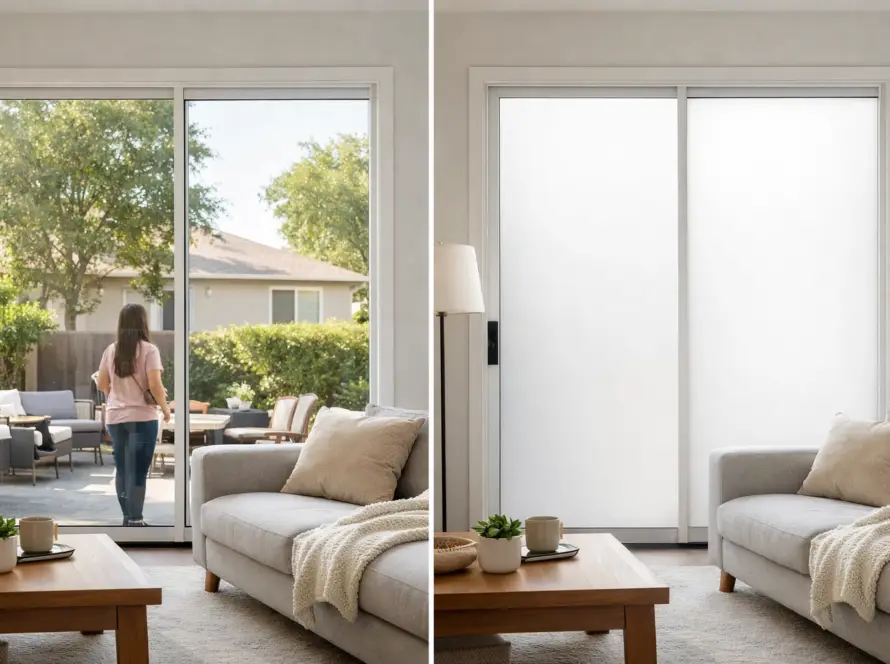
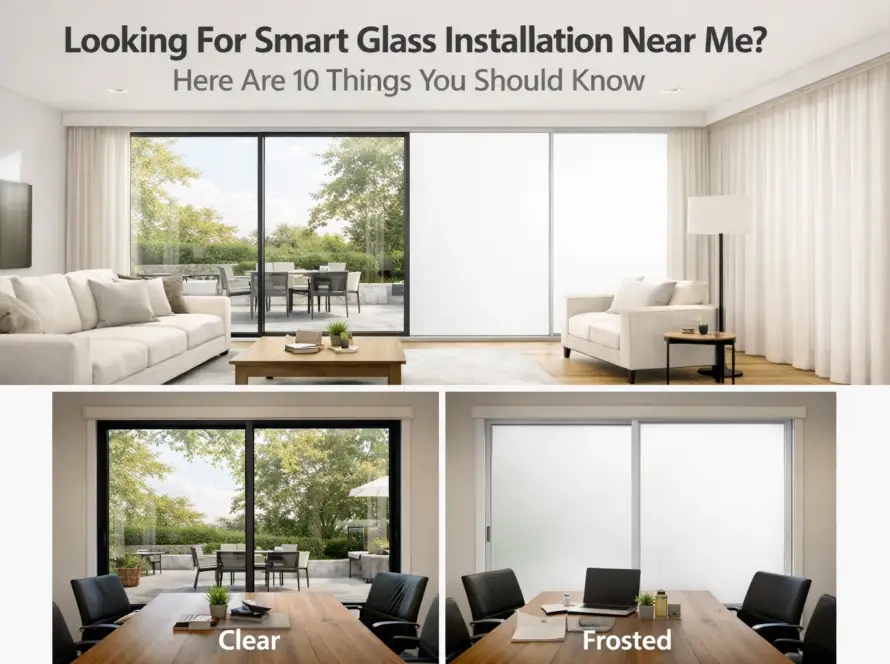
Smart glass operates on a simple principle: when an electrical current is applied, the liquid crystals align to allow light through, making the glass transparent. When the current is removed, the crystals scatter, creating an opaque frosted effect. To manage this through a centralized system, the installation requires precise voltage regulation and compatible control interfaces. Utilizing custom smart glass systems ensures that the hardware is built to handle the rigorous demands of 24/7 automation cycles.
How Does PDLC Technology Interface with Home Automation?
The core of any smart glass system is the PDLC layer. This material typically requires 48V to 60V AC to maintain a clear state. Because home automation systems like Savant and Lutron primarily operate on low-voltage DC signals or proprietary communication protocols (such as Clear Connect or IP), a bridge is necessary. This bridge is usually a dedicated power supply unit (PSU) equipped with a remote-trigger input.
From a technical standpoint, the automation system treats the smart glass transformer as a switchable load or a motor. The control processor sends a signal to a relay or a contact closure interface. When the relay closes, the circuit to the smart glass transformer completes, sending the required AC voltage to the film and turning it clear. This binary state: on for clear, off for opaque: is the foundation for all programming logic within the smart home environment.
What Hardware is Required to Connect Smart Glass to Lutron Homeworks?
Lutron Homeworks QS and QSX systems are the gold standard for lighting and shading control. To integrate smart glass, you typically use a Lutron QSE-IO (Input/Output) interface or a CCO (Contact Closure Output) on a logic power module. The CCO acts as a dry contact that tells the smart glass transformer when to engage.
When designing the system architecture, ensure the transformer is located in a ventilated AV rack or a dedicated electrical closet. High-quality professional smart film installation involves running 18/2 or 16/2 shielded wire from the glass electrodes to the transformer, and then low-voltage control wire (such as Cat6 or Lutron blue hose) from the transformer to the Lutron processor. This configuration allows the glass to be programmed as a "Zone" within the Lutron Designer software, enabling it to be controlled by SeeTouch keypads, Alisse wall stations, or the Lutron App.
How Do You Program Savant Scenes for Privacy Glass?
Savant’s integration relies heavily on its ability to communicate via IP, RS-232, or relays. For smart glass, the Savant SmartControl or any Savant Host with GPIO (General Purpose Input/Output) ports is used. The integrator creates a "General Switch" profile in the Savant Blueprint software.
The true power of Savant integration lies in "Scenes." For example, a "Movie Night" scene can be programmed to lower the Lutron shades, dim the DALI-controlled lights, and switch the smart glass partitions to opaque simultaneously. Because Savant is highly visual, the end-user sees a toggle on their TrueControl interface or Pro Remote that reflects the real-time state of the glass. In Southern California, many high-end estates use this to manage privacy in master suites and wine cellars where instant opacity is required without the mechanical movement of traditional drapes.
Why is Low-Voltage Wiring Design Essential for Smart Film?
The success of an integrated smart film project depends on the "pre-wire" phase. Unlike standard electrical fixtures, PDLC film is sensitive to voltage drops and improper grounding. If the distance between the transformer and the glass exceeds 50 feet, the wire gauge must be increased to prevent "flickering" or incomplete clearing of the crystals.
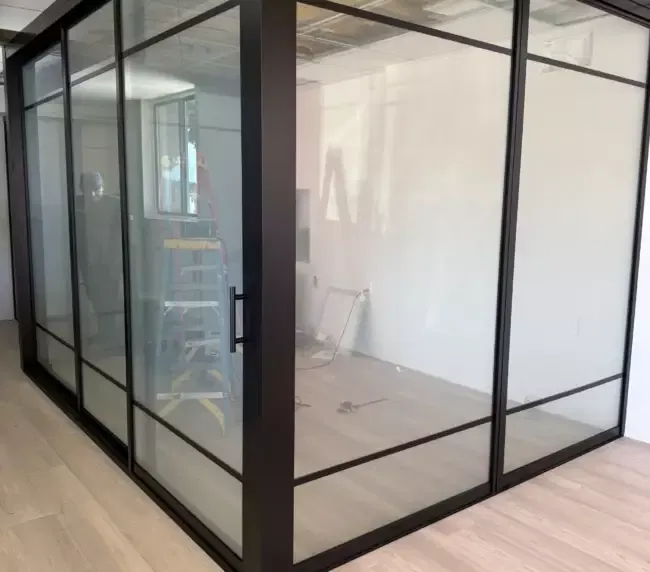
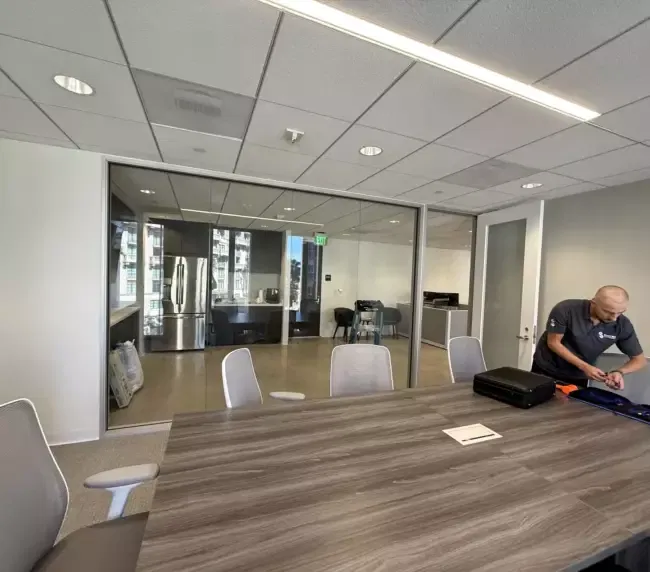
Proper wiring also involves the use of bus bars or specialized connectors concealed within the window frame. For retrofit applications, the wiring is often routed through the glazing pocket. If the window is operable (sliding or swinging), a power transfer cable or "door cord" must be installed to maintain the electrical connection while the window moves. This technical precision is why many developers view completed installations to understand how the hardware is concealed within minimalist architectural frames.
What are the Benefits of Integrating Smart Glass into a Centralized System?
Beyond the "cool factor," centralizing control offers significant performance advantages:
- Energy Management: Integration allows the glass to switch to opaque during peak sunlight hours. This blocks up to 99% of UV rays and significantly reduces Infrared (IR) heat gain, lowering the HVAC load.
- Component Longevity: Smart glass should not be left "on" (clear) for 24 hours a day, as this can shorten the lifespan of the PDLC molecules. An automated system ensures the glass defaults to "off" (opaque) at night or when the room is unoccupied.
- Aesthetic Continuity: By removing individual wall switches for the glass and moving control to a Lutron keypad or Savant iPad, you maintain a clean, minimalist interior design.
- Security Integration: The glass can be programmed to turn opaque automatically if the security system is armed or if a perimeter sensor is tripped, providing instant visual privacy from the street.
How Do Professional Installers Handle Technical Troubleshooting?
Integration introduces multiple points of failure, from the control code to the physical bus bar connection. Professional installers use a systematic approach to isolate issues. First, the transformer is tested independently of the automation system to ensure the glass clears under direct power. If the glass works manually but not through the app, the issue lies in the relay logic or the CCO programming.
Thermal stress is another technical consideration. In the Southern California climate, glass can reach high temperatures. Installers must ensure the PDLC film is compatible with the glass type (e.g., tempered or IGU) to prevent cracking. To get an accurate assessment of these technical variables, many clients request a custom quote that includes a site survey to evaluate existing glazing and electrical infrastructure.
FAQ
Can smart glass be powered by batteries?
No. PDLC technology requires a constant electrical current to remain clear. Battery power is insufficient and impractical for the voltage requirements of smart glass. The system must be hardwired into the building's electrical system via a dedicated transformer.
What is the response time when triggered by a Savant remote?
The transition is nearly instantaneous. Once the command is sent from the Savant Host to the relay, the glass switches from clear to opaque (or vice versa) in less than 100 milliseconds.
Does integrating with Lutron affect the lifespan of the PDLC film?
Actually, it can improve it. By using Lutron to schedule "off" times during the night, you prevent the film from being energized unnecessarily, which preserves the integrity of the liquid crystal layer over many years.
Can I control individual glass panels or only whole rooms?
Control is entirely dependent on your wiring and relay configuration. If each panel is wired to its own relay, you can control them individually. If they are wired in parallel to a single transformer, they will act as one group.
What happens to the glass during a power outage?
PDLC smart glass is "normally opaque." This means that if the power goes out or the system is turned off, the glass defaults to its frosted, private state. This is a built-in safety and privacy feature.
Integrating these systems requires a deep understanding of both glazing and electrical engineering. For more information on how this technology impacts your building's performance, read our post on How Smart Glass Reduces Energy Costs in Southern California.
Ready to upgrade your home or office with the ultimate privacy solution? At Smart View Smart Film Solutions, we specialize in high-precision integration with Savant, Lutron, and Crestron systems. Our team handles everything from custom fabrication to final programming, ensuring your smart glass performs flawlessly within your automated environment.
Contact us today at (866) 728-9888 to schedule a technical consultation or a site evaluation. Whether you are a homeowner looking for luxury privacy or a developer seeking high-ROI smart building technology, we have the expertise to bring your vision to life. Let’s build a smarter, more private space together.