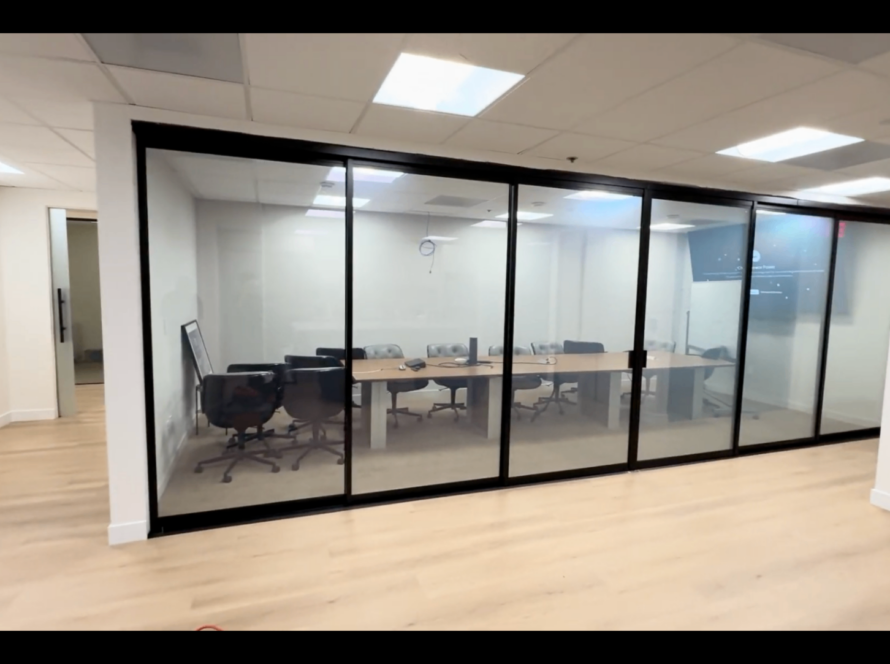
Home Window Privacy Failures: 7 Top Fixes (2026)
Most LA homeowners hit at least one home window privacy failure during the first 5 years of ownership — blinds break, frosted vinyl peels, curtains absorb cooking smells, motorized treatments lose their controller, sun-control film yellows. The seven failure patterns below are the ones we get called in to fix on rescue installs across LA-area residences, and the switchable-glass fix for each is consistently more durable than the alternative being replaced.
This guide catalogs the home window privacy failures we see most often during LA residential consults, with the switchable-glass fix for each. Every pattern below comes from real LA-area service calls and rescue installs we’ve worked in the last 12 months.
The Pattern Behind Most Home Window Privacy Failures
The seven home window privacy failures cluster into three buckets: hardware aging (blinds, motors, controllers), surface degradation (vinyl peeling, fabric staining, film yellowing), and lifestyle mismatch (treatment doesn’t fit how the room actually gets used). Almost every home window privacy failure we get called to fix resolves into one of those three buckets — and the switchable-glass replacement consistently outlasts the original treatment by 5–10 years.
Fix #1 — Broken Mini-Blinds and Failed Slat Mechanisms
The failure. Mini-blind slats break, cords fray, lift mechanisms jam. Standard residential blinds last 3–6 years before slat damage and cord wear push them into replacement territory. Multi-bathroom or multi-bedroom homes hit this failure repeatedly across rooms.
The fix. Quality switchable smart film replaces the entire mechanism with a flat-glass surface and a wall switch — no slats to break, no cords to fail. 10+ year warranted lifespan retires the recurring blind-replacement line item entirely.
Fix #2 — Frosted Vinyl Peeling and Adhesion Failure
The failure. DIY frosted-vinyl applications fail at the edges within 1–3 years — adhesive lets go in humid bathroom environments, vinyl curls inward, the optical effect goes muddy. Common in master baths and ensuite bathrooms where humidity is highest.
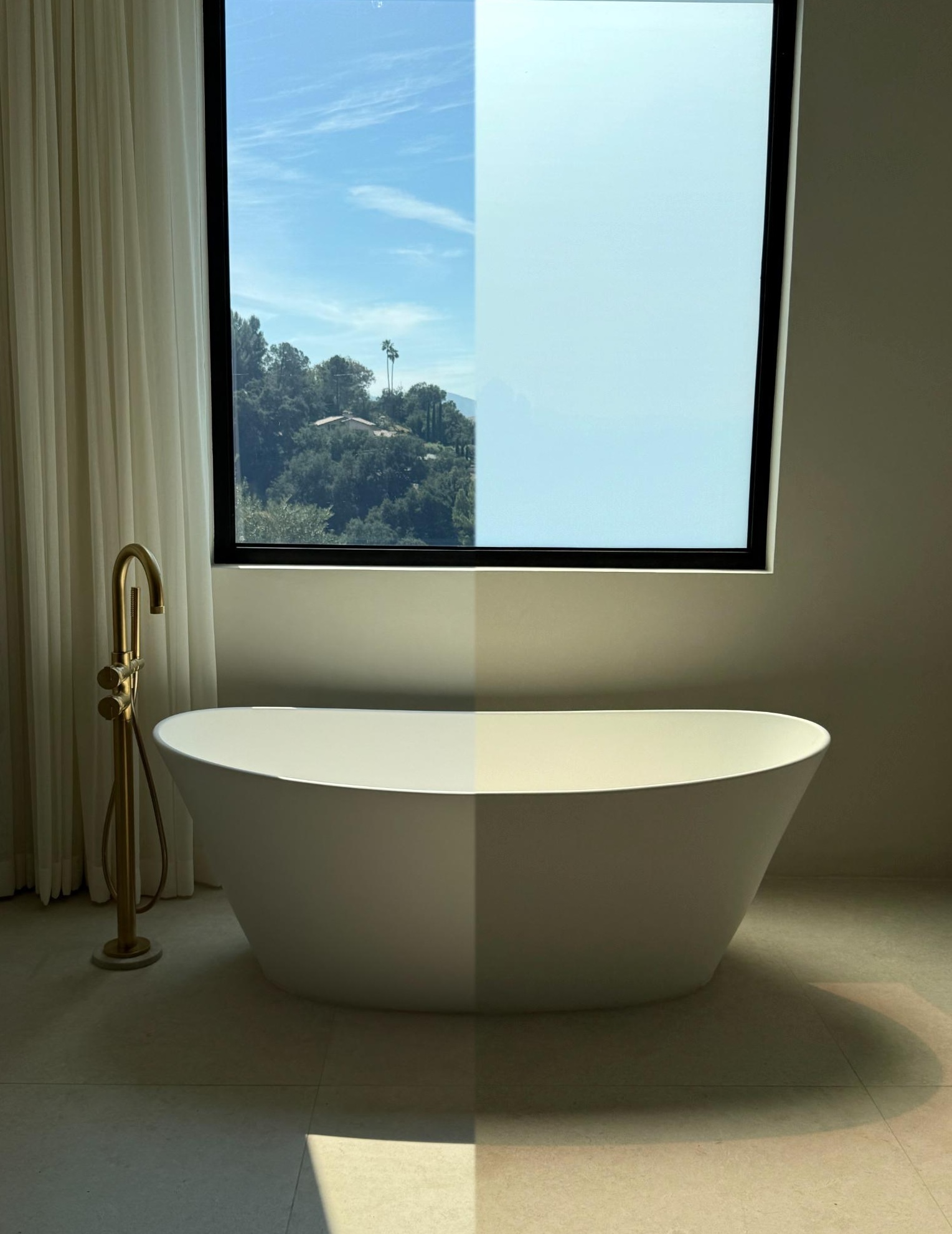
The fix. Professional-grade switchable smart film bonds to the interior face of the existing glass with industrial adhesive engineered for high-humidity environments. Edge integrity holds for 10+ years; no peeling, no curling, no muddy optical effect. Replaces both the vinyl and the bathroom mini-blind that homeowners often layer on top.
Fix #3 — Sun-Control Window Film Yellowing
The failure. Cheap sun-control films yellow over 1–3 years of UV exposure, particularly visible in clear-mode rooms against white walls. The yellowing eliminates the architectural benefit and often forces full removal-and-replacement.
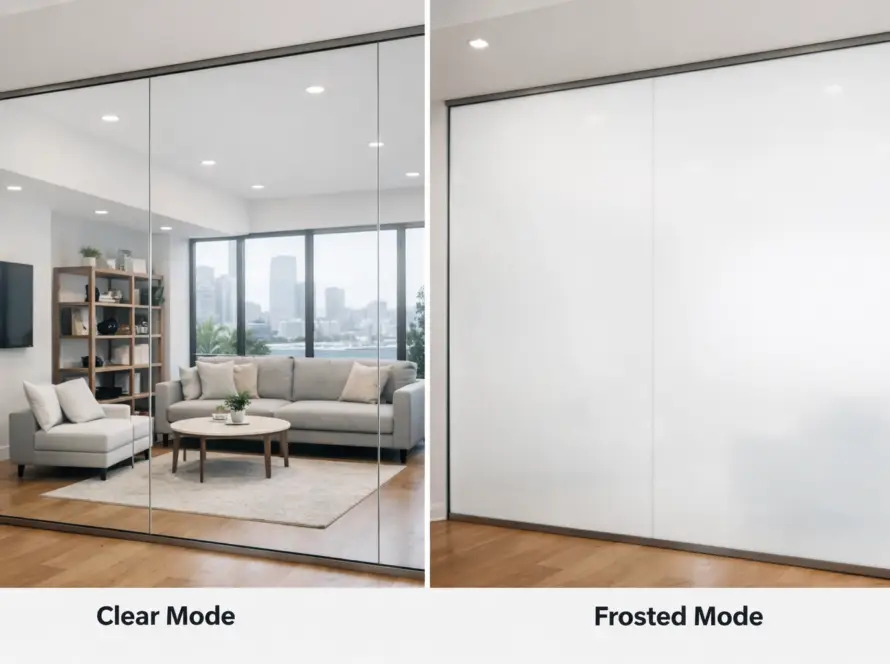
The fix. Quality professional switchable smart film carries UV stabilization rated for indoor service for 10+ years. Yellowing is rare on warranted professional film — and the optical mode (frosted/clear toggle) covers the privacy use case that sun-control film was originally trying to solve indirectly.
Fix #4 — Curtain Cleaning, Allergens, and Fabric Staining
The failure. Curtains absorb cooking smells, dust, and allergens. They need professional cleaning every 12–18 months, and fabric stains accumulate even with regular cleaning. Multi-room homes carry recurring cleaning cost across the curtain count.
The fix. Switchable glass is a flat smooth surface — wipes clean in seconds with standard glass cleaner, traps no allergens, and disappears from the cleaning rotation entirely. Particularly meaningful for allergen-sensitive households and for kitchens and dining rooms where cooking residue is unavoidable.
Fix #5 — Motorized-Treatment Controller and Battery Failure
The failure. Motorized blinds and shades depend on controllers and rechargeable batteries that fail in 4–7 years. Replacement parts often go out of production within the failure window, forcing full system replacement instead of part-level repair.
The fix. Switchable smart film runs on a low-voltage driver hard-wired into the home electrical system — no batteries to fail, no proprietary controllers to discontinue. The driver itself is a standard low-voltage component with multi-vendor compatibility for replacement over the install’s lifespan.
Fix #6 — Drapes That Block All Daylight in Privacy Mode
The failure. Closed drapes block 90–98% of incoming daylight, throwing the room into artificial-lighting dependency. Homeowners running drapes during privacy hours pay both in electricity (supplemental lighting) and in lifestyle (rooms feel cave-like).
The fix. Switchable glass in frosted mode preserves roughly 60–70% of incoming daylight as soft diffused light — privacy without the room going dark. Daylight retention is one of the strongest lifestyle wins on the switchable-glass replacement story; homeowners notice immediately.
Fix #7 — Mismatched Privacy Treatment for Hybrid-Work Spaces
The failure. Home offices and dual-use rooms get treated with whatever privacy spec the previous room had — blinds repurposed from a bedroom, vinyl from a bathroom, drapes from a living room. The treatment doesn’t fit hybrid-work patterns (video calls, focus blocks, family overlap) and adds friction to the daily workflow.
The fix. Switchable smart glass adapts to any room context — hands-free voice triggering for video-call privacy, scheduled mode for focus blocks, integration with the smart-home hub for family-zone coordination. Fixes the spec mismatch that’s behind most home window privacy failures in hybrid-work spaces.
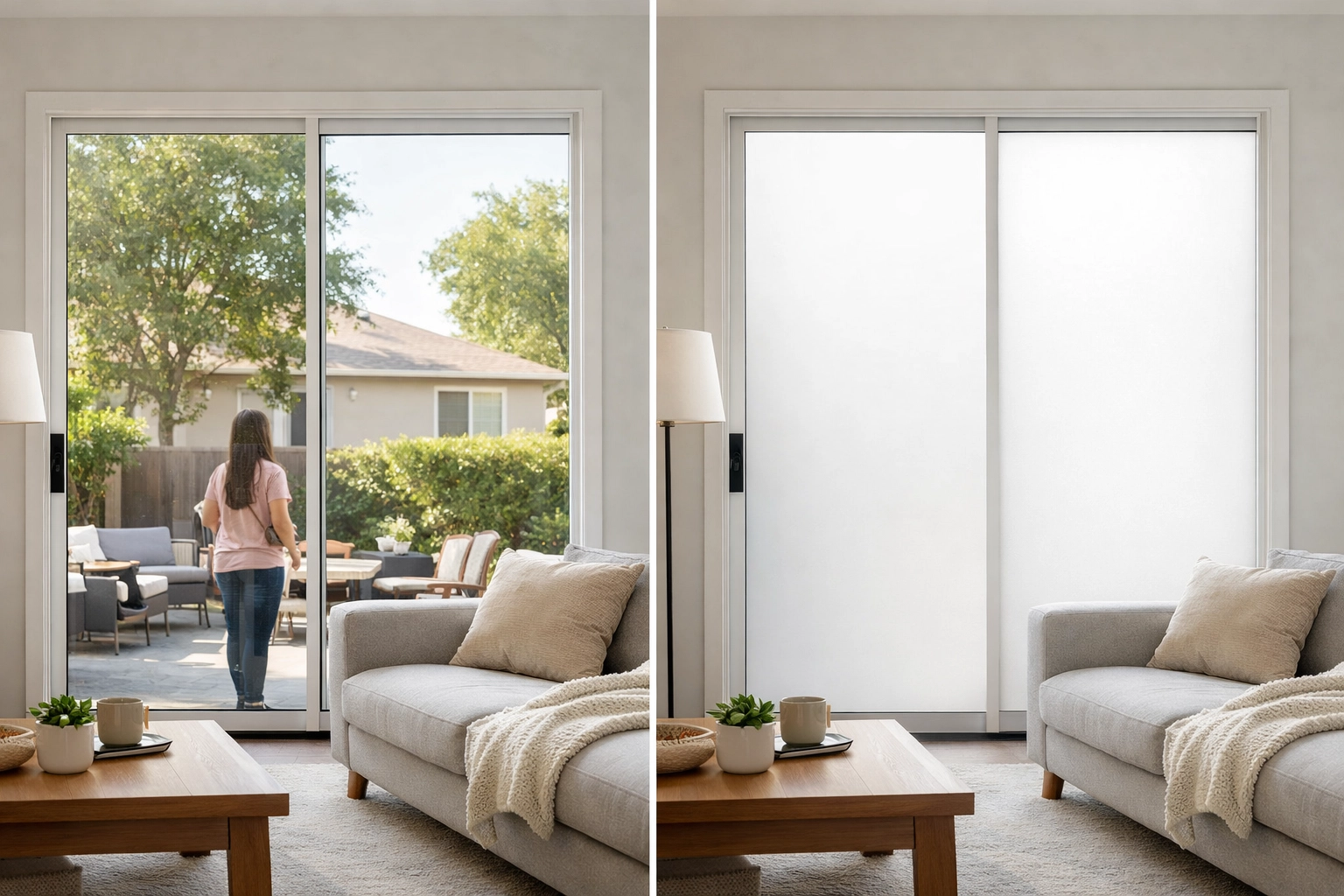
For broader context on the LA-region install service framework that supports switchable-film rescue installs across the seven failure patterns, see our smart film installation in Los Angeles overview — covers the install side and the city-coverage notes that apply to retrofits replacing failed traditional treatments.

How Home Window Privacy Failures Compound on Multi-Room Homes
On a single bathroom window, any one of these home window privacy failures is recoverable in isolation. On a multi-room residence with bathroom + bedroom + dining + living-room glass all carrying different aging treatments, the same home window privacy failures repeat across rooms over staggered timelines — bathroom vinyl peels in year 2, bedroom blinds break in year 4, dining drapes stain in year 5. The cumulative replacement cost across 5 years easily clears the cost of a whole-home switchable-glass install — which is why most LA homeowners hitting two or more home window privacy failures across rooms eventually swap to switchable spec across the house.
An LA French-Door Reference
For a concrete example of the seven home window privacy failures replaced end-to-end on a single residential project, our LA French-door install replaced an aging combination of blinds and frosted vinyl that had hit failures #1, #2, and #6 across the same opening. Switchable smart glass spec resolved all three failure modes in a single retrofit, with Lutron Caseta integration providing the smart-home control layer.
Full project breakdown: smart glass French doors in Los Angeles — single residential scope, retrofit replacing multiple failure modes.
Hitting a Home Window Privacy Failure?
If you’re working through any of the seven home window privacy failures above and considering switchable smart glass as the replacement spec, a 30-minute consult can frame the cost-and-lifecycle math against the specific failures you’re facing. No sales pressure — straight read on whether switchable replacement pencils out for your scope.
Contact Smart View with the room types, current treatment, and the failure mode you’re seeing, and we’ll triage the scope and outline the retrofit path.